Governance
GOV-1 – The role of the administrative, management and supervisory bodies
Management Board
Composition and diversity of the Management Board
The Management Board of Energie AG Oberösterreich is composed of three members. It was made up of 100% male members in the 2024/25 fiscal year. The average age of the members of the Management Board is approximately 55, with the youngest member of the board being 45 and the oldest member being 64. As of January 2026, a member of the Management Board will be female.
Commercial Council Dr. Leonhard SCHITTER, MA
Chief Executive Officer (CEO), Chairman of the Management Board
born 16 October 1967; doctorate in law, master’s in European energy management. Joined Energie AG in 2023, appointed CEO as of 1 January 2023. Term of office ends: 31 December 2027.
Supervisory Board mandates in material entities included in the Consolidated Financial Statements:
Entity |
|
Position |
|---|---|---|
Energie AG Oberösterreich Umwelt Service GmbH |
|
Supervisory Board member, |
Ennskraftwerke AG |
|
Supervisory Board member |
Salzburg AG für Energie, Verkehr und Telekommunikation |
|
Supervisory Board member |
Board mandates with other organisations:
Entity |
|
Position |
|---|---|---|
Oesterreichs Energie |
|
Vice president |
Verbund Hydro Power GmbH |
|
Supervisory Board member |
Association of Industrial Companies (Industriellenvereinigung) |
|
Member of the Federal Board |
Association of Industrial Companies Upper Austria (Industriellenvereinigung OÖ) |
|
Member of Management Board |
Chamber of Commerce Upper Austria |
|
Representative of the industrial sector in the Economic Parliament |
Council for Research and Technology |
|
Member |
Energy Institute of Johannes Kepler University Linz |
|
Vice president |
OÖ Energiesparverband |
|
Member of Management Board |
Trade Association of Gas and Heat Suppliers |
|
Member |
Commercial Council Mag. Dr. Andreas KOLAR
Chief Financial Officer (CFO), member of the Management Board
born 5 July 1961; degree in business administration, doctorate in social sciences and economics. Joined Energie AG in 1997, appointed to Management Board on 1 January 2012. Term of office ends: 31 December 2025.
Supervisory Board mandates in material entities included in the Consolidated Financial Statements:
Entity |
|
Position |
|---|---|---|
Energie AG Oberösterreich Umwelt Service GmbH |
|
Supervisory Board member |
Netz Oberösterreich GmbH |
|
Supervisory Board member, |
Ennskraftwerke AG |
|
Supervisory Board member |
Salzburg AG für Energie, Verkehr und Telekommunikation |
|
Supervisory Board member, |
Board mandates with other organisations:
Entity |
|
Position |
|---|---|---|
Trade Association of Gas and Heat Suppliers |
|
Member |
There will be a change in the Management Board in the 2025/26 fiscal year. Commercial Council, Mag. Dr. Andreas Kolar will retire after many years at Energie AG at the end of the calendar year 2025. His successor in the position of chief financial officer, Mag. Eva Schinkinger, was appointed by the supervisory board of Energie AG on 27 March 2025 with effect from 1 January 2026.
Dipl.-Ing. Alexander Kirchner, MBA
Chief Technology Officer (CTO), member of the Management Board
born 8 November 1979; degree in ‘Industrial Environmental Protection and Process Engineering’, Professional MBA in ‘Controlling and Finance’. Joined Energie AG in 2024, appointed as a member of the Management Board as of 1 August 2024. Term of office ends: 31 July 2029.
Supervisory Board mandates in material entities included in the Consolidated Financial Statements:
Entity |
|
Position |
|---|---|---|
Energie AG Oberösterreich Umwelt Service GmbH |
|
Supervisory Board member, Chairman |
Netz Oberösterreich GmbH |
|
Supervisory Board member, Chairman |
Ennskraftwerke AG |
|
Supervisory Board member |
Salzburg AG für Energie, Verkehr und Telekommunikation |
|
Supervisory Board member |
Salzburg Netz GmbH |
|
Supervisory Board member |
Board mandates with other organisations:
Entity |
|
Position |
|---|---|---|
CEWEP-Confederation of European Waste-to-Energy Plants |
|
Vice-President Austria |
TÜV Austria |
|
Administrative Board |
Working methods and distribution of responsibilities within the Management Board
The Management Board manages the Group's affairs and represents Energie AG Group externally. As the body ultimately responsible for sustainability topics, the Management Board makes decisions on the Group's sustainability policy and the associated targets and material actions. The issue of sustainability and consequently the monitoring, management and supervision of the impacts, risks and opportunities is the responsibility of the full Management Board. It is coordinated by the Group Strategy holding unit and developed in partnership with all organisation units of the Group.
In addition to the Austrian Stock Corporation Act (Aktiengesetz), the Commercial Code (Unternehmensgesetzbuch), and the Articles of Association, the actions of the Management Board and Supervisory Board are governed by their respective rules of procedure. The Rules of Procedure of the Management Board regulate the collaboration among the members of the Management Board, the Management Board's information and reporting duties, and transactions that require approval from the Supervisory Board. The Rules of Procedure of the subsidiaries are based on those of the Management Board and contain equivalent or similar provisions. The allocation of portfolios between members of the Management Board is approved by the Supervisory Board and defines the areas of responsibility of the individual members of the Management Board without prejudicing the Board's overall responsibility.
Access to the Management Board's expertise on sustainability
The members of the Management Board of Energie AG have training in economic, legal and environmental sciences and long-standing management experience in areas relevant to ESG, such as energy, waste management and the circular economy, project development and plant engineering. On this basis, they contribute a high degree of technical and practical competence to sustainable decision-making processes.
Their knowledge is continuously updated through active participation in specialised panels, regular exchanges within the intra-group sustainability organisation, and ongoing reporting to the Supervisory Board and the public. This ensures that the Management Board can systematically identify, assess and manage significant environmental, social and governance-related risks, opportunities and impacts.
The members of the Management Board of Energie AG also have a wide range of experience in relation to the relevant sectors, products and geographic locations of the company.
Supervisory Board
Composition and diversity of the Supervisory Board
The Supervisory Board advises and oversees the management board. This committee comprises a minimum of six and a maximum of 20 (currently 14) members elected by the General Meeting (shareholder representatives) as well as members appointed by the Works Council in line with the Austrian Labour Constitution Act (employee representatives, currently seven). The members of the Supervisory Board (shareholder representatives) are elected by the General Meeting on a rolling basis in accordance with § 87 of the Austrian Stock Corporation Act (Aktiengesetz, AktG).
Employee representatives are appointed in line with § 110 of the Austrian Labour Constitution Act (ArbVG) and the provisions of the regulation governing the appointment of employee representatives to the Supervisory Board (AR-VO).
In accordance with § 86 para 7 of the Austrian Stock Corporation Act (AktG), women must comprise at least 30% of the Supervisory Board, with this figure rounded up or down to the nearest whole number. For the Supervisory Board of Energie AG Oberösterreich, this currently means a total of at least six women, whereby, based on the resolution passed by the capital representatives, the two Supervisory Board committees (capital representatives and employee representatives) must fulfil this quota separately.
The term of office for Supervisory Board members terminates at the end of the General Meeting that rules on approving actions for the fourth fiscal year following the election or appointment, unless they were elected for a shorter term; the fiscal year in which the election takes place is not counted. Re-elections are possible.
Shareholder representatives
Provincial Councillor Commercial Council Markus ACHLEITNER, Chairman, Aichkirchen
Solicitor Mag. Stefan LANG, LL.M., Vice-Chairman, Linz
Chief Executive Officer Dr. Heinrich SCHALLER, Deputy Vice-Chairman, Linz (retired on 17 December 2024)
Chief Executive Officer Mag. Reinhard SCHWENDTBAUER, Deputy Vice-Chairman, Linz (since 17 December 2024)
Head of Administrative Department Dr. Miriam EDER, MBA, Linz
Chairman of the Management Board Mag. Dr. Erich ENTSTRASSER, Innsbruck (retired on 27 March 2025)
Managing Director Mag. Dr. Christiane FRAUSCHER, Linz
Member of Management Board Mag. Florian HAGENAUER, MBA, Linz
Chief Executive Officer Dipl.-Ing. Erich HAIDER, MBA, Linz
Deputy to Chief Executive Officer Commercial Council Mag. Michaela KEPLINGER-MITTERLEHNER, Linz
Dr. Elisabeth KÖLBLINGER, Vöcklabruck
Member of Management Board Dipl.-Ing. Dr.-Ing. Michael KRAXNER (since 27 March 2025)
Member of Management Board Mag. Kathrin Renate KÜHTREIBER-LEITNER, MBA, Linz
Head of Local Parliamentary Group, Member of State Parliament, Commercial Council Ing. Herwig MAHR, Linz
Gertrude SCHATZDORFER-WÖLFEL, Zipf
Thomas Peter STADLBAUER, MSc MBA MPA, Linz
Provincial Councillor Commercial Council Markus Achleitner, chairman of the highest governance body, is not a senior executive of the Energie AG Group.
Employees’ representatives
Ing. Peter NEISSL, MBA MSc, Head of Works Council, Hartkirchen
Pamela NEUER, Head of Works Council, Leonding
Edith SCHMID, Head of Works Council, Perg
Ing. Bernhard STEINER, Head of Works Council Group Representatives, Ottensheim
Gerhard STÖRINGER, Head of Central Works Council, Zell am Pettenfirst
Christian STROBL, Head of Works Council, Gampern
Andreas WALZER, Head of Works Council, Wels
Working methods and distribution of responsibilities within the Supervisory Board
The Supervisory Board convenes as necessary, and at least four times a year and does not fulfil any operational tasks.
The Supervisory Board has one permanent committee for Management Board-related matters and one Audit Committee. The committee for Management Board-related matters comprises four shareholder representatives appointed by resolution of the full Supervisory Board. When appointing members of the committee for Management Board-related matters, the full Supervisory Board also appoints the chairperson of the committee. The proceedings of the committee for Management Board-related matters is defined in the rules of procedure for the Supervisory Board.
The Audit Committee set up by the Supervisory Board in accordance with § 92 para. 4a AktG is made up of six shareholder representatives appointed by resolution of the full Supervisory Board and three employee representatives appointed from the ranks of all employee representatives by simple majority in line with § 32a AR-VO. One member of the Audit Committee must be a person with relevant knowledge of the requirements of the company and practical experience in the field of finance and accounting as well as reporting (financial expert). When appointing members of the Audit Committee, the full Supervisory Board also appoints the chairperson of the committee. The proceedings of the Audit Committee are defined in § 92 para 4a AktG and the rules of procedure for the Supervisory Board.
In accordance with § 75 AktG, the Supervisory Board appoints members of the Management Board for a maximum of five years. As Energie AG Oberösterreich is subject to the rulings of the Court of Auditors, the provisions of the law on transparency in the filling of positions in state-affiliated companies (Stellenbesetzungsgesetz) are observed.
According to prevailing opinion, members of the Supervisory Board have a duty of loyalty and allegiance to the Company, thereby prioritising the well-being of the Company over possible other interests. The Supervisory Board must remain loyal to the Company, and the interests of the Company must always guide its actions.
Before the election, persons proposed must present to the General Meeting their professional qualifications, vocational or similar functions along with all circumstances that could give rise to cause for concern over partiality. The employees are represented on the Supervisory Board by members of the Works Council.
According to § 95 para 5(12) of the Austrian Stock Corporation Act, the conclusion of contracts with members of the Supervisory Board which oblige those members to perform services outside of their Supervisory Board activities for the Company or a subsidiary (§ 189a(7) of the Austrian Commercial Code) for remuneration of a not inconsiderable value shall require the consent of the Supervisory Board. The same applies to contracts with companies in which a Supervisory Board member has a significant business interest.
Access to the Supervisory Board's expertise on sustainability
The members of the Supervisory Board have sustainability-related expertise in areas relevant to Energie AG, such as environmental protection, energy supply, creating a good working environment, and equal treatment and equal opportunities.
Board members are continually deepening and developing their skills in monitoring sustainability matters. Already in the 2023/24 fiscal year, Energie AG offered the members of the Supervisory Board and the Management Board the opportunity to attend a professional development event to further expand their knowledge of sustainability.
The Supervisory Board members of Energie AG have experience in relation to the relevant sectors, products and geographical locations of the company.
This extensive expertise, combined with constant monitoring of current developments, provides a solid foundation for the management and monitoring of sustainability topics within the Energie AG Group, as well as the resulting impacts, risks and opportunities. The Supervisory Board or the chairman of the Supervisory Board may call on experts to deal with individual decisions.
|
|
2024/25 |
|
2023/24 |
|
Comparison |
|---|---|---|---|---|---|---|
Number of members in management |
|
3 |
|
3 |
|
0.0 |
Number of members in supervisory bodies |
|
21 |
|
21 |
|
0.0 |
Total |
|
24 |
|
24 |
|
0.0 |
|
|
2024/25 |
|
2023/24 |
|
Comparison |
|||
|---|---|---|---|---|---|---|---|---|---|
Male |
|
16 |
|
16 |
|
0.0 |
|||
Female |
|
8 |
|
8 |
|
0.0 |
|||
Others |
|
0 |
|
0 |
|
– |
|||
Not reported |
|
0 |
|
0 |
|
– |
|||
Total number of administrative and supervisory bodies |
|
24 |
|
24 |
|
0.0 |
|||
|
|
in % |
|
in % |
|
±%points |
|||
Male |
|
66.7 |
|
66.7 |
|
0.0 |
|||
Female |
|
33.3 |
|
33.3 |
|
0.0 |
|||
Others |
|
0.0 |
|
0.0 |
|
– |
|||
Not reported |
|
0.0 |
|
0.0 |
|
– |
|||
Gender diversity1) |
|
50.0 |
|
50.0 |
|
0.0 |
|||
|
|||||||||
Roles and responsibilities in relation to the oversight of the process for managing material impacts, risks and opportunities
The Supervisory Board, as the body ultimately responsible for the legality of the sustainability statement, subjected the Sustainability Statement for the 2024/25 fiscal year to an independent, voluntary, external audit conducted by an auditor, addressed strategically relevant sustainability matters as well as sustainability-related impacts, risks and opportunities, and reported on these to the General Meeting in accordance with § 96 of the Stock Corporation Act (AktG).
The sustainability statement for the 2024/25 fiscal year was audited on behalf of the Supervisory Board by Deloitte Audit Wirtschaftsprüfungs GmbH in the form of an audit with limited assurance.
The Board of Directors is responsible for monitoring the impacts, risks and opportunities.
As part of the Group-wide strategy and organisational project ‘LOOP’, both organisational and content-related decisions were made in the 2022/23 fiscal year to ensure the implementation of the CSRD within the Group. For operational implementation, the ‘ESG Management/CSRD Implementation project’ was launched in December 2023 and successfully completed in December 2024 as planned. In the 2024/25 fiscal year, the roles and structures established in the project were integrated into the scheduled organisation of Energie AG.
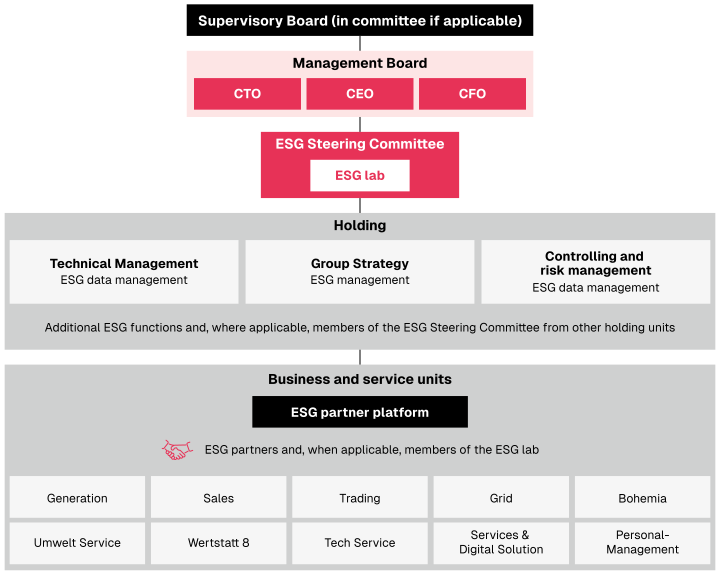
Alongside the implementation of ESG sustainability management in the Group strategy and ESG data management for S and G topics in the Controlling and Risk Management holding unit and for E topics in the Technical Management holding unit, other organisational units are closely involved.
To ensure ongoing exchanges on ESG topics between the holding company and the business and service units, the ESG Partner Platform was set up with the ESG partners already established for all areas of the Group.
The ESG Steering Committee and the ESG Lab were designed as advisory bodies to the Management Board to assist in decision-making at holding level, with the required interfaces defined.
The impact, risks and opportunities are collected by the operating entities. Group-wide consolidation is carried out by the controlling and risk management holding unit.
In addition to the training event on ESG topics, which was already offered to the members of the Supervisory Board and the Management Board in the 2023/24 fiscal year, training opportunities on sustainability topics were made available in the 2024/25 fiscal year to persons involved in the ESG organisation. All senior executives within the Group were also able to participate in a specific training course on the topic of ‘sustainable leadership’ as part of the ESG training programme that was developed. In addition, the employees of Energie AG were able to participate in an ‘action day on sustainability and climate protection’ as well as further training by means of an e-learning module on the basics of ESG management.
The governance structure of the Energie AG Group is based on decisions passed by the governing bodies, articles of association, rules of procedure and Group-wide policies. Group policies establish binding control measures and uniform framework conditions, regulations for specific circumstances, and standardised structures or processes for the respective defined scope. The Group policy ‘Rules for the creation and amendment of Group policies’ defines the standardised review and approval process for all Energie AG Group policies. Drafts of new or amended policies will be sent to the relevant holding managers, managing directors and the Group representative to allow them to comment. The commenting process is clearly documented in an accompanying protocol. Once the procedure has been completed, the finalised policy and the commenting process will be submitted to the Management Board for decision.
The implementation of strategic goals in the sustainability area is assured by linking them closely to the structured annual strategy process. The relevant management teams are responsible for implementing ESG policies in the business and service units. To monitor the achievement of targets, a concept for ESG management logic was developed in the 2024/25 fiscal year, which will be implemented gradually in the coming years.
GOV-2– Information provided to and sustainability matters addressed by the undertaking's administrative, management and supervisory bodies
In the reporting period, the Management Board, Supervisory Board and senior executives of Energie AG regularly received information about sustainability matters and about the process and the results of the company's material impacts, risks and opportunities assessment, and were partly involved in the materiality process. See also IRO-1 – Description of the process to identify and assess material impacts, risks and opportunities.
The ESG Steering Committee was convened three times in the 2024/25 fiscal year and informed about current ESG topics through the ESG management or the relevant departments. ESG management reported five times during the reporting period to the Management Board at its meetings, which subsequently reported to the Supervisory Board twice. In December 2024, the Supervisory Board was informed, inter alia, of sustainability strategies and approaches, metrics and targets. Reporting to the Management Board and Supervisory Board on the ESG impacts, risks and opportunities based on the current ESRS materiality assessment took place in June 2025.
The Supervisory Board receives reports on ESG impacts, risks and opportunities twice a year. Material financial risks and opportunities are reported to the Supervisory Board by the risk management team on a quarterly basis as part of the structured risk management process that has been in place for many years; see Notes to the Consolidated Financial Statements, Risk and Opportunity Management. The Supervisory Board is informed of progress on the targets set in the ‘LOOP’ strategy and organisation project through a quarterly report detailing the quantitative implementation status of the individual actions by department. A more detailed account of developments on the most significant metrics is presented annually to the members of the Supervisory Board.
A list of the material impacts, risks and opportunities addressed by the Management Board of Energie AG in the reporting period can be found in section SBM-3 Material impacts, risks and opportunities and their interaction with strategy and business model.
Shareholder structure
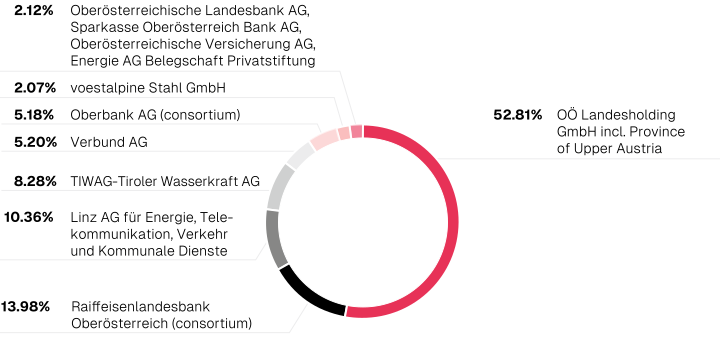
Energie AG Oberösterreich is a joint stock company with the following shareholder structure in the 2024/25 fiscal year:
GOV-3 – Integration of sustainability-related performance in incentive schemes
At the Energie AG Group, senior executives with budgetary responsibility who report to the Management Board of Energie AG Oberösterreich (board members/managing directors, holding company managers and department heads) are included in the ‘Management by Objectives’ (MbO) system, see S1-1 – Own workforce, ‘Management by Objectives’ (MbO). These senior executives can earn annual MbO bonuses (variable remuneration) based on the targets set for the respective fiscal year and the extent to which these targets are achieved. The specific wording of the target agreements remains confidential.
In the 2024/25 fiscal year, the members of the Management Board of Energie AG Oberösterreich were not included in any monetary incentive schemes, whether based on sustainability or other metrics. Members of the Management Board receive a fixed salary. Moreover, no climate-related key performance indicators (KPIs) were taken into account in the remuneration of the members of the Management Board or the Supervisory Board. The shareholder representatives on the Supervisory Board shall receive an annual remuneration for their activities, which is established by the General Meeting and is staggered according to position (chairman, vice-chairman, member) and committee membership. In addition, the shareholder representatives on the Supervisory Board will receive remuneration for each meeting in which they attend.
With regard to embedding sustainability matters in the company's incentive systems, initial steps were taken in the 2023/24 fiscal year as part of the current strategy and further developed in the past fiscal year. For example, specific targets based on the ‘LOOP’ 2035 strategy were assigned to the responsible senior executives at the first and second management levels below the Management Board (managing directors and heads of holding companies; department heads) and embedded as personal targets in the MbO system.
The Management Board of Energie AG Oberösterreich approves and updates the terms and conditions of the incentive schemes.
GOV-4 – Statement on due diligence
The ‘ESG Management/CSRD Implementation’ project included defining the individual steps and sub-processes involved in ESRS sustainability reporting. In the 2024/25 fiscal year, these were further developed and the material process risks and ESG control activities were developed and documented under the Internal Control System (ICS). The processes used by the company to meet its due diligence obligations with regard to sustainability matters are described in the respective related sections.
The following overview indicates the sections of the sustainability statement in which the key elements of due diligence process can be found:
Quality, safety and environmental management
Customer proximity, transparency and process traceability are top priorities for Energie AG as a quality provider. The whole of Energie AG in Austria and two entities in the Czech Republic are fully certified according to the international standard for a quality management system under ISO 9001:2015.
An integrated quality, safety and environmental (QSE) management system with a focus on sustainability and maximum efficiency is an integrated component of the management systems used by the Energie AG Group (excluding the Czech Republic Segment). As part of the Company's due diligence measures, the ISO 9001:2015 standard for quality management systems is applied as a Group-wide standard that contributes towards efficient design, continuous improvement and transparent presentation of operational processes and procedures.
There is at least one QSE liaison assigned to all applicable Group companies and holding units. These liaisons are responsible for operational implementation of the QSE management system.
To ensure compliance with relevant environmental and occupational safety requirements, the experience gained from the environmental management standards ISO 14001:2015 and EMAS (‘Eco Management and Audit Scheme’) and occupational health and safety in accordance with ISO 45001:2018 from the already certified companies serve as useful guidelines.
The integrated QSE management system ensures the continuous improvement of the Energie AG Group’s services through the active involvement of executives, employees and customers. Regular examination from internal audits and by independent external and accredited certification bodies guarantees top product and service quality, as well as the best possible processes for customers and partners. The high standard of the QSU management system was confirmed by a monitoring audit conducted by TÜV Süd Landesgesellschaft Österreich GmbH from 19 March 2025 to 4 July 2025.
All Energie AG units that have adopted these externally certified quality, safety, environmental and health management systems have structured processes to identify negative impacts on the environment and employee health, which can then be prevented or mitigated accordingly.
All staff in Austria and northern Italy work at entities certified in accordance with quality management standard ISO 9001:2015. In addition, according to the needs of the respective segments, there were further certifications as shown in the table below. 28.72% of the Austrian and Italian workforce is employed at entities certified to environmental management standard ISO 14001:2015. In addition, 27.90% of employees in Austria work in accordance with the Group’s environmental management system EMAS, while 41.31% of Group employees work in units certified under ISO 45001:2018. The additional and specific standards ISO 14001:2015 and EMAS were implemented for the Environment Segment (previously the Waste Management segment), which accounts for 25.81% of employees in Austria, from 2010 and 2013. See S1-14 – Metrics for health and safety.
The Grid Segment is certified to QS-GNB 200 (quality requirements for gas grid operators) and TSM P100 (technical safety management in electricity grids) of the ‘Austrian Association for Gas and Water’ (ÖVGW). The audit concerned industry-specific requirements pertaining to the assessment of gas and electricity grid operators with regard to the qualification and organisation of their technical units. Other certifications held by Netz Oberösterreich GmbH (Netz OÖ GmbH) include ISO 9001:2015 and, since the 2020/21 fiscal year, ONR 192500:2011 concerning the social responsibility of organisations (CSR). The CSR goals are closely linked with the QSE management system of Netz OÖ GmbH. As with the QSE management system, internal and external audits are regularly carried out in the CSR area to review compliance with the standard and to uphold and renew certification. Certification under ISO 17025:2018 (requirements for the competence of testing and calibration laboratories) was also obtained. In the 2024/25 fiscal year, the information security management system (ISMS) of Netz Oberösterreich GmbH (Netz OÖ GmbH) was reviewed as part of a recertification audit in accordance with ISO/IEC 27001 and was converted to the new standard 27001:2022. It was confirmed to be compliant without conditions. In addition, Netz OÖ received certification in accordance with ISO/IEC 27019:2017 for the first time. Netz OÖ GmbH is also subject to the NIS Act (Austrian Network and Information Security Act) with the scope ‘Energy sector for the operation of an electricity distribution system’ and demonstrably fulfils the requirements set by it. This provides a solid basis for the planned restructuring of the energy system. In the 2022/23 fiscal year, Netz OÖ GmbH also became the first Austrian grid operator to be certified in line with ÖVGW QS-GNB 300 (quality requirements on gas grid operators for calorific value determination).
The Environment Segment is certified in the areas of quality (ISO 9001:2015), occupational health and safety (ISO 45001:2018), and environment (ISO 14001:2015), and as a qualified waste management operator on the basis of the regulation governing the requirements on waste management operators (RAEF). Umwelt Service GmbH was the first nationwide waste management company that implemented the current version of the EMAS Certification (Regulation [EC] No. 1221/2009) at all its locations back in 2013. Umwelt Service GmbH has also been certified under EU Regulation 333/2011 (End of Waste Regulation Scrap Metal, Ötztal and Timelkam sites), SURE (‘Sustainable Resources Verification Scheme’), the RAL mark of quality (for the demanufacturing of refrigeration units in Timelkam) and ISO 14024:2018 (resources potential for the demanufacturing plant for refrigeration units in Timelkam). WDL-WasserdienstleistungsGmbH (WDL GmbH) is also subject to the NIS Act (Austrian Network and Information Security Act) with the scope ‘Water collection and piped water distribution’ and demonstrably fulfils the requirements set by it.
The entities in the Czech Republic are not subject to the Energie AG Group QSE management system. In accordance with the requirements of the respective subsidiaries in the Czech Republic Segment, the two Czech entities ČEVAK, a.s. and VaK Beroun a.s. are certified in accordance with the international standards ISO 9001:2015, ISO 14001:2015 and ISO 45001:2018. This means that just over two thirds of the employees in the Czech Republic work in entities that are certified under quality, environmental and occupational safety standards.
The Generation business unit is certified in the Quality area (ISO 9001:2015). In addition, the Timelkam power plant location is certified in the environment area (ISO 14001:2015) and the annual environmental statement meets the requirements of the EMAS Regulation. The use of sustainable biomass for electricity and heat generation in the Generation business unit is ensured by a ‘Sustainable Resources Verification Scheme’ (SURE). Production is also subject to the NIS Act with the scope ‘Operation of the combined-cycle gas turbine power plant (CGGT) at the Timelkam site / Operational management of the Timelkam CGGT power plant’ and demonstrably meets the associated requirements. In addition, the Generation business unit operates a management system in accordance with ISO 27001:2022 for its area of responsibility, which is continuously developed but not externally certified.
Netz OÖ GmbH as well as the Group IT Services and Digitalisation department and the Telco department (formerly Energie AG Oberösterreich Telekom GmbH (Telekom GmbH)) of Energie AG Oberösterreich Services und Digital Solutions GmbH (Services und Digital Solutions GmbH) are additionally certified in accordance with the information security management standards ISO 27001:2013 and 27001:2022.
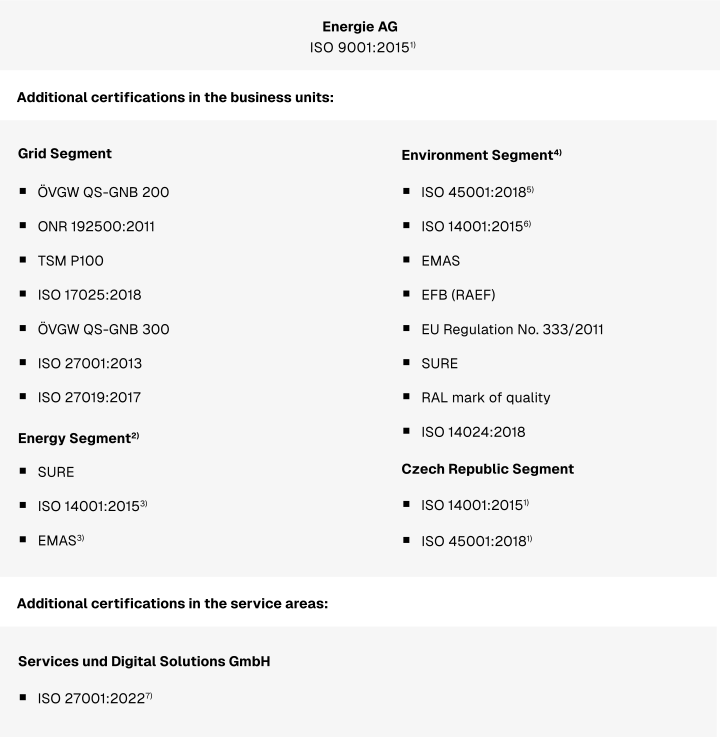
2) Excluding Energie AG Oberösterreich Trading GmbH (Trading GmbH) and Energie AG Oberösterreich Vertrieb GmbH (Vertrieb GmbH).
3) Timelkam power plant location.
4) Umwelt Service GmbH.
5) incl. WDL GmbH.
6) WDL GmbH and Energie AG Südtirol Umwelt Service GmbH (Südtirol Umwelt Service GmbH).
7) IT Services and Digitalisation department and Telco department of Services und Digital Solutions GmbH.
ISO 27001:2013, ISO 27019:2017, TSM P100, ÖVGW QS-GNB 200, ÖVGW QS-GNB 300, ISO 17025:2018, RAL mark of quality, ISO 14024:2018 and SURE are audited and certified separately, not as part of QSE matrix certification.
The governance risk compliance (GRC) management tool implemented in the 2019/20 fiscal year has reached the planned scope of use. The processes of the Group companies (with the exception of the Czech Republic Segment) are mapped in this GRC management system, together with their success factors. The tool has been in use for internal and external audits including the associated action monitoring since fiscal year 2020/21.
GOV-5 – Risk management and internal controls over sustainability reporting
Given the growing importance of sustainability topics to business activity, aspects of ESG have been incorporated into risk management. The Group-wide risk management system is used to anticipate and manage potential risks and opportunities at an early stage.
In the 2024/25 fiscal year, the double materiality assessment required by ESRS was performed by the business and service units in cooperation with the Group risk management. The assessment of the individual impacts, risks and opportunities was carried out in a decentralised manner by the respective business and service units. Compared to the previous year, when the analysis was carried out centrally in the framework of workshops, this represents a further step towards integration into the line organisation.
The impacts, opportunities and risks identified in this way were subjected to an assessment using a group-wide uniform assessment method. A net presentation of these impacts, opportunities and risks was produced and appropriate risk minimisation and negative impact minimisation measures were implemented.
The materiality assessment process following the principle of ‘double materiality’ in accordance with the new ESRS guidelines is described in detail in section IRO-1 – Description of the process to identify and assess material impacts, risks and opportunities. For further information on the Group-wide risk management and the opportunities and risks of Energie AG, please see the Group Management Report, Risks and opportunities, and the Notes to the Consolidated Financial Statements, Management of risks and opportunities.
The sustainability statement is reviewed by the holding company in a comment process before it is submitted to the Management Board for signature.
For information on the risk assessment approach used, including the method used to prioritise risks, see the section on Management of impacts, risks and opportunities.
In the context of sustainability reporting, there are these risks: On the one hand, reporting may be incomplete unless all the material topics have been correctly identified and, on the other hand, there is a potential risk of reporting on issues that are not material. There is also a risk that erroneous data will be included, which could render the contents of the reports incorrect.
For the production of ESRS-compliant sustainability reporting, a central core process including the associated risks and control activities was anchored and documented in the Energie AG Internal Control System (ICS) during the reporting period. Sub-processes were derived from this main process and implemented in Energie AG's internal control system.
In order to minimise the identified process risks, ESG control activities have been implemented in the ICS. All documented control activities comply with the internal rules of a standardised ICS (four-eyes principle, representation rules, proof of control).
The management of Energie AG is responsible for integrating reliable and compliant sustainability reporting in the ICS of Energie AG. Responsibilities for the collection, processing and validation of sustainability-related information are regulated across the Group through an integrated ESG Partner Platform. This platform ensures the structured involvement of all the relevant departments and is represented organisationally and systemically in both the ICS and the corresponding system of Energie AG. This structure ensures that the results of the risk assessment and the related internal control measures are effectively integrated into the relevant internal functions and processes.
Regular reporting on the results of the materiality assessment and the associated risk assessments and internal control activities relating to the process of sustainability reporting to the management and supervisory bodies will be integrated into the relevant roles and processes.
As part of the cyclical ICS audits carried out by the Group Internal Audit holding unit, the ESG controls will also be reviewed in terms of their design and effectiveness and audited from the 2025/26 fiscal year onwards. Group Internal Audit reports on the results of its audits and on the status and effectiveness of the ICS within the Group at the Audit Committee meetings held twice a year.