
Strategy
SBM-1 – Strategy, business model and value chain
Strategy
The Energie AG Group is a provider of electricity, gas, heat, water, energy, waste management, and information and communication services, and aligns its products, processes and services with a strong focus on reliable availability. The Grid Segment comprises the construction and operation of the electricity and gas grid as the backbone of the electricity and gas supply in Upper Austria. The Energie AG Group also operates heating, fibre-optic (backbone) and e-charging networks.
Energie AG is headquartered in Linz, Upper Austria. Its market area currently includes Austria, the Czech Republic, Italy and Slovenia. The targets defined in the current strategy are to be achieved through organic growth, but also through M&A activities, where Germany is also defined as a growth market for wind and/or PV.
In the 2024/25 fiscal year, shares in several companies were acquired; see Group Management Report, Changes under Corporate Law.
For the quantitative data on employees see S1-6 – Characteristics of company's employees.
|
|
2024/25 |
|
2023/24 |
|
Comparison |
|---|---|---|---|---|---|---|
Energy |
|
1,853.3 |
|
2,248.2 |
|
-17.6 |
Grid |
|
427.9 |
|
377.3 |
|
13.4 |
Environment |
|
280.3 |
|
269.6 |
|
4.0 |
Czech Republic |
|
248.1 |
|
235.1 |
|
5.5 |
Holding & services |
|
32.4 |
|
29.5 |
|
9.8 |
Total |
|
2,842.0 |
|
3,159.7 |
|
-10.1 |
|
|
2024/25 |
|
2023/24 |
|
Comparison |
|---|---|---|---|---|---|---|
Coal |
|
0.0 |
|
0.0 |
|
– |
Oil |
|
0.0 |
|
0.0 |
|
– |
Gas |
|
672.1 |
|
721.4 |
|
-6.8 |
Fossil fuels |
|
672.1 |
|
721.4 |
|
-6.8 |
Chemicals production |
|
0.0 |
|
0.0 |
|
– |
Category of controversial weapons |
|
0.0 |
|
0.0 |
|
– |
Cultivation and production of tobacco |
|
0.0 |
|
0.0 |
|
– |
Total |
|
672.1 |
|
721.4 |
|
-6.8 |
The Taxonomy-eligible or Taxonomy-aligned sales revenues are listed in the EU Taxonomy section.
A structured strategy process is a prerequisite for consistent control over the Energie AG Group’s long-term business development. Strategy development and financial planning interact through a clearly defined process. Strategies and measures are derived from market development analyses, the evaluation of the business activities' effects in an economic, ecological, and social context (monitoring processes, certifications etc.), the balancing of the Group's strategic goals with the interests and expectations ascertained during the ongoing dialogue with stakeholders and the energy policy environment (new statutory requirements etc.). The operating efficiency, profitability and progress of the energy transition are always essential.
In the 2024/25 fiscal year, two strategy meetings were held at Group level as part of the annual strategy process. In April 2025, the focus was on current market and environmental developments as well as the strategic guidelines for the entire Group. As part of this process, decisions were made on strategic priority topics and Group-wide projects in the areas of digitalisation, circular economy, hydrogen and decarbonisation. At a further Group strategy meeting in July 2025, the strategic directions and individual perspectives were refined and discussed in greater depth between the Management Board, managing directors of the Group companies and holding company managers. In addition, the strategy meeting focused on promoting cross-departmental objectives and cooperation.
Transformation to a sustainable energy system
Energie AG has a clear strategic focus on the transformation to a sustainable energy system. The key objectives are decarbonisation, increasing renewable energy production and supporting national and European climate targets.
Investments in photovoltaics, wind power, hydroelectric power and new technologies, such as green hydrogen and battery storage, make a significant contribution. By 2035, the production of electricity from renewable energy sources from all companies and holdings in the Group will be increased by more than 1.0 TWh.
The challenges posed by increasing decentralisation of energy generation require increased investment in grid infrastructure and storage facilities. In addition to the necessary developments with regards to flexibility, Energie AG pools its expertise with strategic partners to bring together innovative, environmentally and economically sensible products and services to the market. Any changes in the legal framework, such as a relaxation of political and climate targets, and any resulting measures, such as a lack of subsidies and customers' unwillingness to pay, pose risks that may cause the Group's strategic targets not to be achieved until a later date.
Decarbonisation
Energie AG has made decarbonisation along the entire value chain a strategic priority, with the sustainability objective of achieving net zero by 2050 while continuing to guarantee reliable energy supply and waste management and ensuring affordability. This aims to promote the energy transition, harness opportunities for sustainable development, such as the creation of new business models, and mitigate the risk of steadily increasing CO2 prices. A detailed transition plan for climate change mitigation in accordance with the ESRS requirements is being developed and is expected to be published in the 2025/26 sustainability statement.
Energie AG is forging ahead with the energy transition by expanding its range of sustainable products and services and transforming heat supply, as well as by optimising its own use of resources.
Digitalisation and innovation
A strategy and organisation project defined key innovation areas to enable new products and services in the fields of decarbonisation, electromobility and photovoltaics. Since then, a dedicated corporate innovation unit has consolidated and coordinated these activities. In the 2024/25 fiscal year, the ‘Next Level’ digitalisation project was also launched, focusing on further developing operational excellence through the use of AI and process automation, optimising the data landscape, continuously improving the digital customer experience and empowering all employees in the successful implementation of digitalisation. Netz OÖ GmbH is simultaneously advancing the further development of the digital customer portal.
Circular economy and biodiversity
The responsible use of natural resources is firmly embedded in Energie AG’s strategy and represents a central element of the current transformation agenda. Particular emphasis is placed on the economical and efficient management of resources. Promoting the circular economy plays a key role in this context. To harness existing potentials and to develop further courses of action relating to the circular economy, a dedicated project was launched for the gradual development and implementation of measures.
The next step is the development of a biodiversity strategy aimed at safeguarding the long-term ecological diversity of natural habitats. Initial measures to minimise the impact on existing ecosystems are already being implemented. Development projects will only be carried out in combination with comprehensive environmental monitoring and/or the creation of replacement habitats for affected species. The biodiversity strategy will be further developed over the coming fiscal years.
Hydrogen
To reduce its own CO2 emissions while ensuring future security of supply, Energie AG is pushing ahead in further diversifying its energy generation portfolio. This includes the promotion and deployment of new climate-friendly technologies, for example through participation in research projects on the production and subsequent use of green hydrogen. A key element of these efforts is the establishment of a hydrogen starter network, which was approved for the first time in the 2024/25 fiscal year as part of the long-term and integrated planning process (LFiP). Initial measures for the distribution of green hydrogen via the existing gas grid were implemented in the Sattledt–Linz section.
Partnerships and supply chains
Energie AG takes its role as a buyer very seriously. Supplier suitability is assessed during the procurement process in accordance with the relevant guidelines. A comprehensive supplier screening system is currently being implemented and is intended to play an increasingly important role in minimising sustainability-related supplier risks in the future. In addition, Energie AG has defined clear principles in its existing ‘Code of Conduct for Contractors’, which is based on the OECD Guidelines for Multinational Enterprises and is binding for contractors and subcontractors of the Group. These policies are designed to ensure, among other things, that employees within the value chain are treated fairly and with dignity, in line with fundamental human rights.
Employees, culture and diversity
Energie AG positions itself as a fair and attractive employer. To underline the relevance of this commitment, particular emphasis has been placed on the areas of diversity, equal opportunities and inclusion (DEI), supported by the interdisciplinary ‘DiversiTeam’. Another key objective of the multi-year DEI process is to maintain and further strengthen an open corporate culture based on transparency, mutual respect and appreciation; this culture is intended to create space for change - an essential prerequisite for the Group’s strategic realignment - by enhancing employee satisfaction and thereby increasing innovation and productivity. The strategic goal of increasing the share of women in senior management positions has been defined across the Group as a means of providing targeted support. An equal opportunities network has also been established to empower underrepresented groups.
An essential cornerstone of the Group’s sustainable internal culture is an anonymous ‘whistleblowing system’, which encourages employees to report grievances without fear of negative consequences (such as harassment or dismissal).
From the outset, the ‘LOOP’ strategy and organisation project was accompanied by a culture and change initiative. Even after the project phase was completed, targeted culture-enhancing measures have continued to ensure alignment between the company’s cultural orientation and its strategic objectives. A particular focus lies on the involvement of key stakeholders. This includes, in particular, senior executives at all hierarchical levels who, in their role as multipliers, play a decisive part in shaping the cultural transformation. Employees are also actively involved: a community of change agents acts as ambassadors across all areas of the Group, while all employees can contribute their own initiatives on the topics of future viability, cooperation and partnerships, customer experience, responsibility, sustainability and diversity via the ‘Kulturkompass’ platform and make them visible.
Energie AG also strengthens its attractiveness as an employer through targeted personnel development initiatives, a more balanced gender distribution at management levels and an inclusive working environment, supported by training and education programmes as well as health and family support measures.
Customer satisfaction and service quality
Energie AG’s business activities are fundamentally geared towards ensuring the highest possible levels of security of supply and waste management, alongside maximising customer satisfaction. Consequently, one of the key objectives of the ‘LOOP’ strategy and organisation project is to deliver an outstanding ‘customer experience’ that is strongly aligned with customer needs and expectations, thereby further enhancing the Group’s positive public reputation. This is supported by digitalisation measures, dedicated service hotlines, online platforms and regular surveys. Customers are actively involved in development processes, including participation in a six-monthly customer forum. Information security and data protection are ensured through an established information security management system.
Economic viability and Energie AG's contribution to the Sustainable Development Goals (SDGs)
The Group's financial stability and robust creditworthiness are an essential prerequisite for systematically implementing the described transformation towards sustainability, while consistent sustainability management also plays a major role in securing future financial success. Financial stability and strong creditworthiness are underpinned by the Group's balanced mix of liberalised and regulated business models and by robust risk and opportunity management.
Energie AG actively contributes to the achievement of the United Nations' Sustainable Development Goals with its strategic positioning in combination with its individual projects and service offerings. The main emphasis is on meeting SDG 7: Affordable and clean energy, SDG 8: Decent work and economic growth, SDG 9: Industry, innovation and infrastructure, SDG 10: Reduced inequalities, SDG 12: Responsible consumption and production and SDG 13: Climate action.
The focus of the Group's current and future investments is on the ongoing expansion of renewable electricity generation from sources such as water, sun and wind, and the ecological transformation of the energy market. An efficient electricity grid is essential both for the energy transition and for ensuring a reliable electricity supply for customers. In addition, Energie AG is investing in many other sustainable initiatives, such as the development and expansion of storage technologies such as battery storage and pumped-storage power plants, sustainable heating initiatives, e-mobility infrastructure and the emerging fields of hydrogen and green gases.
In the 2024/25 fiscal year, 80.7% of the Group's total investments were dedicated to expanding electricity generation from renewable sources, expanding and maintaining the Austrian electricity grid, and other sustainable activities. Approximately 12.1% was allocated to renewable electricity generation, 54.4% to investments in electricity grids and 33.5% to other sustainable activities.
Business model and Group structure
Energie AG's business model is centred on energy generation, the construction and operation of grids and the reliable supply of electricity, gas and heat to end users. Customers in Austria are also offered energy, information and communication services, as well as e-mobility solutions. The Group offers an integrated waste management and waste management solutions to its customers in Austria and northern Italy, while those in the Czech Republic are supplied with drinking water, heat and wastewater management services.
Energie AG primarily relies on the Return on Capital Employed (ROCE) and the operating result (EBIT) for its internal management and assessment of the Group's earning power. The goal of the Energie AG Group is to generate an ROCE above the WACC through consistently value-oriented corporate management and control. For more information on the value management concept as an instrument for controlling economic success, see the Group Management Report, Value-based corporate management and capital costs.
As a competent, competitive and responsible company, Energie AG provides its customers with value-added products and services, transparent pricing and strong regional availability. Since its foundation in 1892, this has helped to create a general spirit of partnership between the Energie AG Group and its customers, employees, suppliers and the general public.

Energie AG is organised in a Group structure. Management and Group functions are pooled in the holding company. The business and service units are organised in the form of individual companies. In addition to the line and project organisation, the Group has an established crisis and emergency management system in Austria with regular drills and meetings convened as required.
The following diagram depicts the six business units and the three service units as of 30 September 2025.
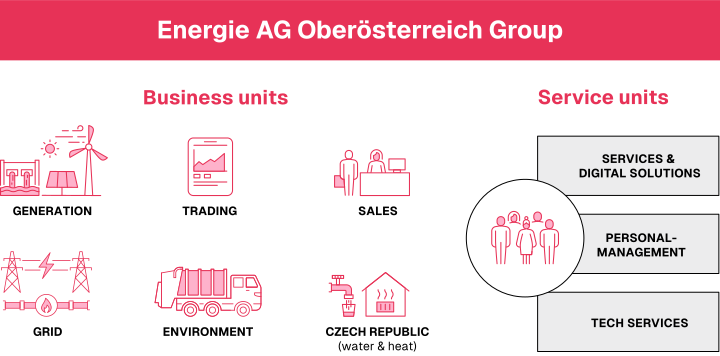
Energie AG's business activities are divided into five segments in accordance with IFRS reporting:
The Energy Segment, Group Management Report, comprises the Group’s core business activities: the generation and storage of electricity and heat, the trading of energy and energy-related products, electricity and gas sales, heat supply in Austria, the implementation of hydrogen production plants, and the provision of telecommunications services. The range of services also includes selected energy services, such as energy audits for large organisations, energy performance certificates and building modernisation plans, charge cards for electric vehicle charging stations, specialised on-site power purchase agreement (PPA) models and system optimisation strategies.
The Grid Segment, Group Management Report, comprises the construction and operation of the electricity and gas grid as the backbone of electricity and gas supply to large parts of Upper Austria and parts of Lower Austria, Salzburg and Styria by Netz OÖ GmbH, a fully owned subsidiary of Energie AG. Netz OÖ GmbH is responsible for securing the energy supply in Upper Austria.
The Environment Segment, Group Management Report, offers integrated waste management services and customised waste management solutions in Austria and Northern Italy. This includes the collection, acceptance, treatment, sorting, management and incineration of domestic and commercial waste, including slag processing, as well as the recovery and reuse of recyclable materials.
The Czech Republic Segment, Group Management Report, provides comprehensive drinking water and heat supply services as well as wastewater management in the Czech Republic. The business models include concession, operator and service contracts, specialised water, wastewater and heating services, as well as construction and installation activities. Cities, local authorities, associations, industrial enterprises, housing companies and housing cooperatives are the contractual partners who form the Czech Republic Segment’s client base.
In addition to the management and control functions of the holding company, the Holding & Services Segment, Group Management Report, comprises the Telecommunications business area, commercial and technical services and some subsidiaries consolidated at equity that are not assigned to other Segments. The commercial and technical service companies mainly provide services for the business units.
The Telecommunications unit, which is now part of Services und Digital Solutions GmbH, is responsible for providing preliminary telecommunications service products throughout Energie AG's supply area and telecommunications and telematics services for the Group, and for setting up and operating the backbone network for the external market. The telecommunications unit provides not only bandwidth but also services in the layer 3 area (internet connectivity and telephone equipment) for Vertrieb GmbH.
Disclosures about changes under corporate law during the 2024/25 fiscal year are provided in the Group Management Report, Changes under corporate law.
Value chain
Energie AG's business model essentially covers four value chains: Energy (electricity, gas and heat), waste management, drinking water and wastewater and general utilities.
Energy (electricity, gas and heat)
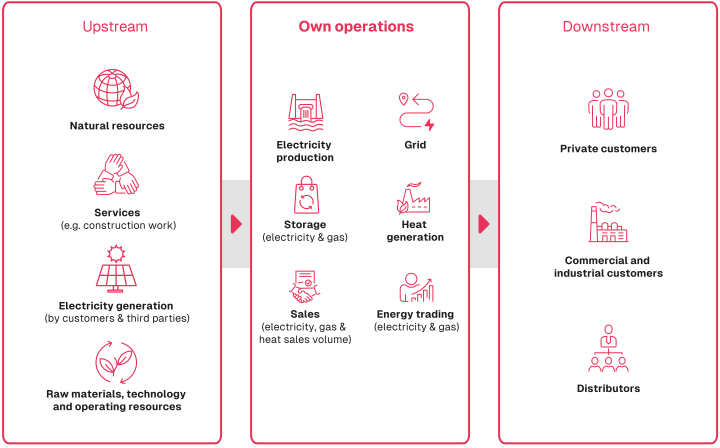
The upstream value chain covers the use of natural resources such as water, sun, wind, gas, (biogenic) waste and biomass.
The commodities, materials, operating resources and technical equipment needed for the construction, expansion and maintenance of power plants and grid infrastructure are obtained primarily from external suppliers. This also comprises services such as IT support and maintenance and construction services. In the Czech Republic Segment, energy suppliers likewise represent key actors within the value chain.
The Energie AG Group's own operations within the electricity value chain include the generation, storage, trading, transport, distribution and sale of electrical energy. The electricity is generated in the company's own power plants and through procurement rights, with a focus on the use of renewable energy sources such as hydroelectric power, biomass, photovoltaics and wind power. In addition, electricity is generated in gas-fired power plants and through waste incineration, and storage technologies are being developed to synchronise volatile electricity generation from renewable energy sources with demand. The Energie AG Group trades on wholesale exchanges and with over-the-counter (OTC) partners to meet the total electricity demand for its customers and to optimise the Group's electricity portfolio. Electricity is transported through high-voltage lines and substations. Netz OÖ GmbH operates the public electricity grid in large parts of Upper Austria and in parts of Lower Austria, Salzburg and Styria. This ensures a reliable energy supply for industrial, commercial and private customers across the supply area. Energie AG offers customers a range of electricity products that vary in price, origin and technology used. Energie AG is supporting the development of smart grids, which facilitate intelligent control of energy generation, consumption and storage and therefore contribute to making the energy system more flexible.
The gas value chain includes the procurement, storage, transport, distribution, use and sale of gas. Energie AG purchases gas on exchanges in Austria, Germany and the Netherlands as well as through bilateral contracts with European partners. No direct contracts are held with natural gas exploration companies or Russian companies. Energie AG is thus contributing to the reduction of dependence on Russian gas by sourcing natural gas for private and commercial customers exclusively from non-Russian origins, in line with Article 9 of EU Regulation 2022/2576. Biogas is produced by third parties from biogenic waste and biomass from farms, municipalities or other suppliers. Energie AG manages gas storage capacities to ensure customer supply, to optimise the structure of the Group portfolio and to realise margins from the price differences between products with different delivery periods. Gas is distributed through a high-pressure and low-pressure grid and partly stored in underground storage facilities. The grid is operated by Netz OÖ GmbH. The gas grid supplies industrial, commercial and private customers in parts of Upper Austria. Energie AG offers customers a range of gas products that vary in price, origin and technology used. In doing so, it encourages the phasing out of gas and oil heating systems in order to reduce CO2 emissions. Energie AG is also supporting the development of power-to-gas systems, that convert surplus electricity from renewable sources into gas and therefore contribute to making the energy system more flexible.
The heat value chain includes the generation, storage, transport, distribution and sale of thermal energy. Energie AG generates and procures district heat and local heat from non-fossil sources such as biomass, geothermal energy, waste incineration and waste heat as well as from gas-fuelled combined heat and power plants and gas boilers. Energie AG Oberösterreich Erzeugung GmbH (Erzeugung GmbH) operates heating networks that ensure supply to industrial, commercial and private customers in Upper Austria. Local heat contracting plants focussing on Upper Austria and areas along the border with Salzburg, Styria and Lower Austria are operated by Vertrieb GmbH. In the Czech Republic, heat is also distributed through external pipe networks. Heat consumption is measured using heat meters. In Austria, Energie AG is promoting the use of renewable heat sources and thermal insulation in order to reduce CO2 emissions. It is also supporting the development of combined heating and cooling plants that generate heat and cooling at the same time and contribute to increasing the flexibility of the energy system in Austria.
Through its subsidiaries, Energie AG develops, constructs and operates pipeline and network infrastructures for electricity, gas, district heating and telecommunications (fibre-optical), ensuring the efficient transport of energy and data to private, commercial and industrial customers.
Electricity, gas and heat are offered and provided to customers (private, commercial and industrial) through various sales channels. Key distribution channels comprise the online platform, exclusive and independent brokers, customer service (by e-mail and telephone), and cooperation with market partners. Austrian customers are supported both in generating their own electricity through PV systems and in feeding it into the public grid. Energie AG also supports the expansion of heat generation from renewable sources using heat pump systems and district heating by providing monetary subsidies, tailored offers and far-reaching advice and information campaigns. Energy advisory services that help customers save energy complete the portfolio.
Environment
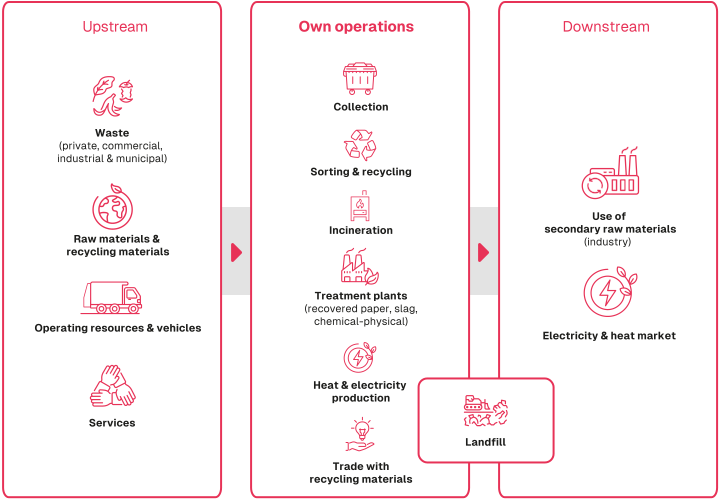
Energie AG operates as both a waste collector and a waste handler in Austria and Northern Italy. This includes the collection, acceptance, treatment, sorting, management and incineration (including slag processing) of domestic and commercial waste, as well as recovery and reuse of recycling materials in this area. The most significant sources of waste are from private households, businesses, industry and municipalities, which either leave their waste to Energie AG or maintain locations from which the waste is collected by Energie AG.
Energie AG uses a variety of processes to convert waste materials into energy and recycling materials. The most common waste recycling processes are sorting, recycling (e.g. refrigerators), chemical-physical treatment and waste incineration, including slag processing, which are carried out in the company's own or external plants. Alongside this, the company also trades in raw materials and recycling materials such as paper, cardboard, metal, etc.
The company purchases operating resources and vehicles, such as waste management vehicles for collecting and transporting waste materials, as well as self-propelled work equipment for on-site handling. Energie AG procures services for plant maintenance, such as those provided by Welser Abfallverwertung (WAV), as well as logistics services, in particular waste-management vehicles and the work performed by HGV drivers for the transport of waste and products. Once the waste has been collected, it is treated, focusing on recovering energy and valuable resources. Sorted and processed waste is used in industry as secondary raw materials.
Energie AG sells energy and recycling materials obtained from waste on a variety of markets and to customers. The customers of Umwelt Service GmbH are primarily business and industrial clients, domestic and municipal customers such as municipalities or waste associations, as well as interregional key accounts and private customers.
In addition to the traditional distribution channels at the sites, these customers are served by internal and external service teams, telephone sales and the online channels ContainerService24.at and Entsorgung24.at. The online portal Containerdienst24.at allows private customers to order containers and skips throughout Austria, 24/7. The main target group is private individuals who need containers for the management or disposal of green waste or construction waste. The service offering was expanded to include the online portal Entsorgung24.at for existing corporate customers. To further improve usability, Entsorgung24.at has also been expanded to include an app. This allows customers to request the collection of containers or other waste receptacles at any time and from any location.
Energie AG generates heat and electricity from waste, which is supplied to end customers via the respective electricity grids and district heating networks. Energie AG also supplies sorted and processed waste to industry as secondary raw materials, which can be used to manufacture new products. Examples include recycling paper and cardboard and recovering metals by processing the slag remaining after waste incineration. Energie AG stores waste materials that cannot be recycled in its own or public landfills.
Drinking water and waste water
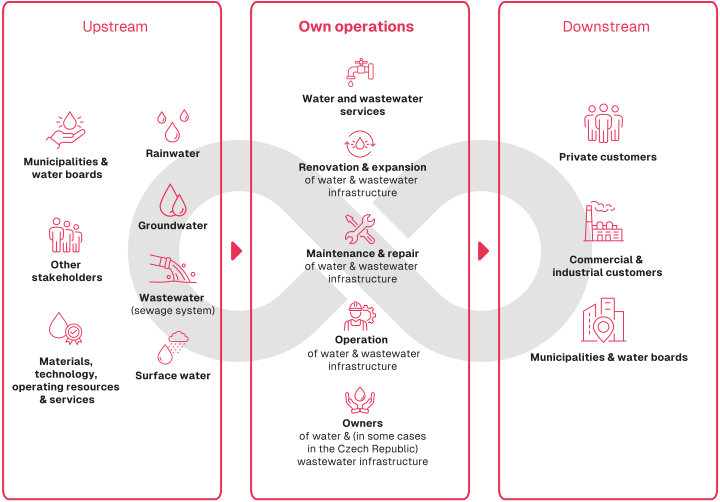
Energie AG offers services for cities, local authorities and water boards for the supply of drinking water, wastewater management and sewage services. It also takes into account the environmental and social impact of its activities along the entire value chain, which is shown in the diagram. Energie AG is committed to the sustainable use of water as a resource and takes action to avoid water loss.
In the Czech Republic, Energie AG holds official licences to extract surface and groundwater for drinking water and to discharge treated wastewater. Water sources for drinking water treatment include surface water (watercourses, lakes, reservoirs or dams) and groundwater, whose quality and quantity are influenced by precipitation (including runoff from urban areas) and discharged treated wastewater. In addition, a variety of materials, technologies and resources are used to conduct business activities.
In Upper Austria, Energie AG holds water law licences for the extraction of groundwater and the operation of its own water supply facilities. The groundwater used meets the legal quality requirements, meaning that no treatment is required for the majority of the installations.
Energie AG operates and partly owns the water infrastructure and carries out regular maintenance and servicing of water supply, sewage, wastewater treatment and water treatment plants, as well as their renovation and expansion, to the extent that they are owned by the Energie AG Group. The Group provides water management services such as sewer and hydrant inspections, leak detection, water sampling and laboratory activities, and employs advanced technologies to optimise operations, including smart metering in the Czech Republic.
Services
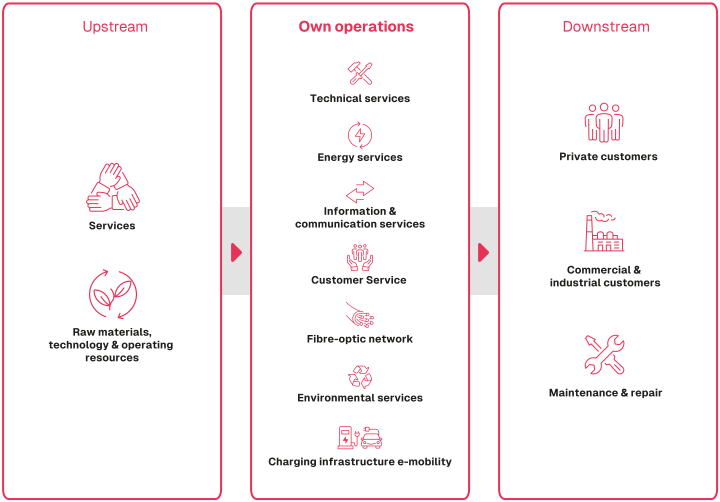
Energie AG offers its customers (private, commercial and industrial) and Group companies a broad portfolio of services that contribute to its environmental, social and economic goals. In order to provide these services, Energie AG procures a range of services from its suppliers and partners, as well as raw materials, technology and operating resources, which it uses sustainably and efficiently.
Energie AG’s range of services extends across a broad spectrum of technical, environmental, energy-related, information and communication, commercial and customer-focused activities; these include technical services such as planning, engineering, construction, maintenance and inspections (e.g. of power plants, generators, motors, transformers and operating equipment), troubleshooting in network-related facilities in the electricity, gas, heating and data transmission sectors, as well as the design and project planning of facilities for electricity and heat generation and storage (such as hydroelectric and thermal power plants, waste incineration plants, heating and gas pipeline construction, biogas plants, and wind and PV installations); environmental services comprise waste collection, treatment, recycling, wastewater treatment and recovery, and contaminated-site remediation consulting; energy services include energy performance certificates and energy audits, energy-efficiency consulting and subsidy management, as well as contracting and hire-purchase models for PV and heating systems; information and communication services cover the development of ICT products, telecommunications services (e.g. internal telephony and telematics services), the construction and operation of the fibre-optic network and related Layer 3 services (internet connectivity and telephony), as well as the operation of fibre-optic infrastructure; commercial services encompass accounting, controlling, procurement, human resources, legal, compliance and risk management: customer services include call-centre operations, the online service portal, the customer magazine and the customer loyalty programme; the Group also operates a dense network of public charging infrastructure for electric vehicles, offering associated – in part digital – services (charging cards, direct payment) and charging-infrastructure solutions for private and business customers.
Sustainable finance
The financial sector plays a key role in enabling a sustainable energy future. ‘Sustainable finance’ ensures that financial and investment decisions are guided by sustainability criteria, making it a central lever for the transition to a climate-neutral and resource-efficient economy.
The transformation process initiated by Energie AG will necessitate ambitious investment programmes over the coming years, especially in energy generation and distribution. As an energy company, Energie AG bears a particular responsibility to integrate sustainable financing approaches into its corporate strategy. In this way, investments can be structured not only to ensure economic viability but also to contribute actively to achieving climate objectives and advancing social progress.
To finance these investments, Energie AG plans to make increased use of instruments from the ‘sustainable finance’ sector. To this end, a ‘Green Financing Framework’ has been established and published, forming the basis for future green and sustainable financing.
The framework sets out Energie AG’s sustainability strategy and the planned green investments that will support the implementation of this transformation. This provides investors and lenders with assurance that the funds made available will be used exclusively for the implementation of sustainable investments. The framework has been evaluated and validated by an independent internationally active expert.
In addition, Energie AG negotiated a far-reaching lending agreement with the European Investment Bank (EIB) in the 2024/25 fiscal year. The committed funds originate from the REPowerEU Action Plan, an initiative of the European Commission to accelerate the energy transition, in particular through the expansion of renewable energy. The EIB financing will be used to support Energie AG’s hydropower projects.
SBM-2 – Interests and views of stakeholders
Energie AG considers the involvement of its stakeholders to be extremely important to ensure that their interests and views are taken into account.
The table below provides an overview of key stakeholders, engagement and dialogue formats, and the relevant topics for the 2024/25 fiscal year.
Stakeholder |
|
Integration and dialogue formats |
|
Sustainability topics |
|---|---|---|---|---|
Customers |
|
Frequency: continuous |
|
Security of supply, energy price development, market development, strategy, greenhouse gas emissions |
Own workforce |
|
Frequency: continuous |
|
Working conditions (remuneration, work-life balance, working hours), safety at work, development, equality, equal opportunities, corporate culture |
Business partners |
|
Frequency: in specific cases where there are clear indications of potential opportunities and risks |
|
Labour conditions, skills shortages, supply chain responsibilities, innovation, market development, greenhouse gas emissions, circular economy |
Competitors |
|
Frequency: continuous |
|
Market development, strategy, products, regulatory developments |
Science and |
|
Frequency: continuous |
|
Innovations, decarbonisation, circular economy, digitalisation, energy generation, storage and transport |
General Public and Media |
|
Frequency: continuous |
|
Strategy, security of supply, energy price development, products and projects |
Nature |
|
Frequency: project-dependent |
|
Studies, collection of actual measures, biodiversity, protection of nature, scientific knowledge |
Politicians and Authorities |
|
Frequency: continuous or as required |
|
Trends in energy and climate policy, development of energy generation from renewable sources, security of supply, energy price development, development of legal requirements, decarbonisation, construction of H2 infrastructure, the circular economy and recycling |
Interest groups |
|
Frequency: continuous |
|
Energy market development, energy price development, working conditions, greenhouse gas emissions |
Landowners and Neighbours |
|
Frequency: project-dependent |
|
Air pollution control, water protection, protection against emissions, waste, biodiversity, transport, landscape protection |
Local Communities |
|
Frequency: continuous |
|
Energy price development, air pollution control, water protection, protection against emissions, waste, biodiversity, projects |
Capital market |
|
Frequency: continuous |
|
Sustainability objectives & risks, sustainable financing, investments, financial market development, strategy, development of legal requirements in banking and finance, greenhouse gas emissions |
Particular attention is given to the stakeholder groups most strongly affected: customers (consumers and end users) and employees (Management Board, senior executives and staff). For further information on current engagement, see S4-2 – Process for engaging with consumers and end users about impacts, and S4-3 – Process to remediate negative impacts and channels for consumers and end users to raise concerns, as well as S1-2 – Process for engaging company employees and workers' representatives about impacts, and S1-3 – Process for remediating negative impacts and channels for company employees to raise concerns, and G1-1 – Corporate governance framework and corporate culture. For information on other relevant stakeholders, such as the value chain workforce, see S2 Workers in the value chain.
The ‘LOOP’ strategy and organisation project (fiscal year 2023/24), launched to sharpen the focus on customer needs—particularly regarding access to products and services and the provision of high-quality information—continued to be implemented during the reporting period. The goal of the strategic repositioning in this area is to significantly improve the customer experience through digitalisation and simplification, see also S4-1 Concepts related to consumers and end-users, ‘Customer experience’ and digitalisation. The associated organisational adjustment continued throughout the 2024/25 fiscal year and creates the foundation for leveraging existing strengths more effectively and further optimising customer processes. The development and design of a needs-orientated customer platform should facilitate the continued expansion of digital customer services in the future. Fully digitalised, highly automated solutions are designed to improve service quality and reduce waiting times, see also S4-4 – Taking action on material impacts on consumers and end users, and approaches to managing material risks and pursuing material opportunities related to consumers and end-users, and effectiveness of those actions.
In the Czech Republic segment, the water companies provide an online comments portal that allows stakeholders involved in construction procedures to submit comments directly on existing water supply networks, investors’ plans, project documentation for planning approval (planning permission) and construction procedures (building notification), development plans, and modifications to water supply, sewerage connections or water metering systems. Comments can also be submitted in person at the customer centre or in writing. Requests for comments on existing infrastructure for the purposes of the construction process are generally received and transmitted by the district heating companies by email or using a data box. The opinion portal is available continuously on the Czech water companies' websites and the information provided is updated to reflect current projects.
Processes for involving the company's own workforce, including through dialogue with employee representatives, with regard to impacts are explained in S1-2 – Processes for involving the company's workforce and workers' representatives with regard to impacts. It also describes the available channels and opportunities for employees to express concerns about negative impacts, as well as procedures to address them under S1-3 Process for remediating negative impacts and channels for own employees to raise concerns, or G1-1 Business conduct concepts and corporate culture.
Based on the concept developed in the 2023/24 fiscal year for the future involvement of stakeholder groups in sustainability matters, prepared by employees from various Group divisions, special consideration was given to employee and customer interest groups when conducting the 2024/25 materiality assessment.
Details on the implementation of the materiality assessment can be found in section IRO-1 – Description of the process to identify and assess material impacts, risks and opportunities.
The ESG Steering Committee and the Management Board of Energie AG Oberösterreich were informed of the perspectives and interests of the ‘employees’ and ‘customers’ stakeholder groups involved in the reporting period as part of the materiality assessment results for the 2024/25 fiscal year. The topics discussed during the workshop with the members of the Group Representative Committee (representing the ‘employees’ interest group) and the results of the analysis of the complaint management system for the ‘customers’ interest group were discussed.
Since the 2024/25 fiscal year, Energie AG has been a member of respACT, the Austrian leading platform for sustainable economic development, thereby reinforcing its commitment to active dialogue with stakeholders, the domestic market and the continuous development of responsible corporate practices.
Since September 2025, Energie AG has also been a member of the Green Energy Lab, a nationwide Austrian innovation platform for sustainable energy solutions. Through this partnership, Energie AG enhances its engagement with key stakeholders — business, academia and policymakers — and supports the development and implementation of new technologies in the fields of renewable energy, networks and decarbonisation.
Respect for human rights
Energie AG is committed to the unrestricted respect of human rights across all areas of its operations and throughout its wider sphere of influence. In its responsible corporate activities, Energie AG is guided by internationally recognised principles and practices such as the Guidelines for Multinational Enterprises of the OECD, the Declaration on Fundamental Principles and Rights at Work of the International Labour Organization (ILO) and the UN Guiding Principles on Business and Human Rights.
The well-being of all persons within its supply area is an important goal for Energie AG Group. The Group focuses its actions on providing a safe and reliable supply that enables well-being, trade and commerce, and a high quality of life.
SBM-3 – Material impacts, risks and opportunities and their interaction with strategy and business model
This section summarises the material positive and negative impacts as well as risks and opportunities of the Energie AG Group's material sustainability matters as identified in the materiality assessment.
For information on the current financial effects of these material risks and opportunities, please refer to the Consolidated Financial Statements.
The interdependence of the material impacts, risks and opportunities with the strategy and business model are described in section SBM-1 – Strategy, business model and value chain.
|
|
IRO |
|
positive impact |
|
Physical facility risk (PR) |
|
actual |
|
Time horizon |
|
own business activity (B) |
|---|---|---|---|---|---|---|---|---|---|---|---|---|
E1 Climate change |
||||||||||||
Climate change adaptation |
||||||||||||
Energy transition infrastructure: |
|
I |
|
+ |
|
|
|
A |
|
short-term |
|
B |
Expansion of charging infrastructure for |
|
I |
|
+ |
|
|
|
A |
|
short-term |
|
B |
Higher investment costs for infrastructure: |
|
R |
|
|
|
PR |
|
P |
|
medium-term |
|
B |
Extreme weather events: |
|
R |
|
|
|
PR |
|
A |
|
short-term |
|
B |
|
|
R |
|
|
|
PR / TR |
|
A |
|
short-term |
|
B |
Climate change mitigation |
||||||||||||
Reducing greenhouse gas emissions: |
|
I |
|
+ |
|
|
|
A |
|
medium-term |
|
N |
Expansion of renewable energy generation and storage facilities: |
|
I |
|
+ |
|
|
|
A |
|
short-term |
|
B |
Biomonitoring: |
|
I |
|
+ |
|
|
|
A |
|
short-term |
|
B |
Negative effects of CO2 emissions: |
|
I |
|
– |
|
|
|
A |
|
short-term |
|
U / B / D |
Price of CO2: |
|
R |
|
|
|
TR |
|
A / P |
|
medium-term |
|
B |
Changing regulations: |
|
R |
|
|
|
TR |
|
P |
|
short-term |
|
B |
Decarbonisation costs: |
|
R |
|
|
|
PR / TR |
|
A / P |
|
long-term |
|
B |
Development of new business areas: |
|
O |
|
|
|
TR |
|
P |
|
short-term |
|
B |
Strengthening existing business areas: |
|
O |
|
|
|
PR |
|
A |
|
short-term |
|
B |
Energy |
||||||||||||
Increased energy generation from renewable energy generation installations: |
|
I |
|
+ |
|
|
|
A |
|
short-term/ medium-term |
|
B |
Provision of electricity network infrastructure: |
|
I |
|
+ |
|
|
|
A |
|
short-term |
|
B |
Energy consumption: |
|
I |
|
– |
|
|
|
A |
|
short-term |
|
B |
Energy security/independence: |
|
O |
|
|
|
TR |
|
A |
|
short-term |
|
B |
Diversity of generation methods (water, PV, wind power): |
|
O |
|
|
|
PR |
|
A |
|
short-term |
|
B |
E4 Biodiversity and ecosystems |
||||||||||||
Impact on the extent and condition of ecosystems – Soil sealing |
||||||||||||
Habitat degradation caused by the construction and operation of installations: |
|
I |
|
– |
|
|
|
A |
|
short-term |
|
B |
Impacts and dependencies on ecosystem services |
||||||||||||
Higher water flow in the winter months: |
|
O |
|
|
|
PR |
|
A |
|
medium-term |
|
B |
E5 Resource use and the circular economy |
||||||||||||
Resource inflows, including resource use |
||||||||||||
Resource use as a result of business activities: |
|
I |
|
– |
|
|
|
A |
|
short-term |
|
B |
Resource recovery as a result of business activities in the Environment Segment: |
|
I |
|
+ |
|
|
|
A |
|
short-term |
|
B / D |
|
|
IRO |
|
positive impact |
|
Physical facility risk (PR) |
|
actual |
|
Time horizon |
|
own business activity (B) |
|---|---|---|---|---|---|---|---|---|---|---|---|---|
S1 Own workforce |
||||||||||||
Working conditions – Working time |
||||||||||||
Work-life balance: |
|
I |
|
+ |
|
|
|
A |
|
short-term |
|
B |
Flexible work time models: |
|
I |
|
+ |
|
|
|
A |
|
short-term |
|
B |
Working conditions - Rights to information, consultation and co-determination |
||||||||||||
Representation of employees' interests by works council: |
|
I |
|
+ |
|
|
|
A |
|
short-term |
|
B |
Transparency on own rights: |
|
I |
|
+ |
|
|
|
A |
|
short-term |
|
B |
Working conditions – Work-life balance |
||||||||||||
Employee satisfaction: |
|
I |
|
+ |
|
|
|
A |
|
short-term |
|
B |
Working conditions – Health and safety |
||||||||||||
Health promotion programmes: |
|
I |
|
+ |
|
|
|
A |
|
short-term |
|
B |
Risk of accidents at work: |
|
I |
|
– |
|
|
|
A |
|
short-term |
|
B |
Working conditions – Secure employment |
||||||||||||
Employee retention and recruitment: |
|
O |
|
|
|
TR |
|
A |
|
medium-term |
|
B |
Ensuring and preserving expertise: |
|
O |
|
|
|
TR |
|
A |
|
medium-term |
|
B |
Equal treatment and equal opportunities for all – Training and skills development |
||||||||||||
Skills development and further development: |
|
I |
|
+ |
|
|
|
A |
|
short-term |
|
B |
Equal treatment and equal opportunities for all – Action against violence and harassment at work |
||||||||||||
Possible bullying: |
|
I |
|
– |
|
|
|
P |
|
short-term |
|
B |
Equal treatment and equal opportunity for all – Diversity |
||||||||||||
Promoting diversity, equal opportunities and inclusion: |
|
I |
|
+ |
|
|
|
A |
|
short-term |
|
B |
S2 Workers in the value chain |
||||||||||||
Working conditions – Adequate wages |
||||||||||||
Possible low pay: |
|
I |
|
– |
|
|
|
P |
|
short-term |
|
U / D |
Working conditions – Health and safety |
||||||||||||
Risk of accidents at work: |
|
I |
|
– |
|
|
|
P |
|
short-term |
|
U / D |
S4 Consumers and end-users |
||||||||||||
Information-related impacts for consumers and/or end users – Access to (high-quality) information |
||||||||||||
Transparent provision of information across multiple channels: |
|
I |
|
+ |
|
|
|
A |
|
short-term |
|
N |
Insufficient/non-transparent customer information: |
|
I |
|
– |
|
|
|
A |
|
short-term |
|
N |
Social inclusion of consumers and/or end-users – Access to products and services |
||||||||||||
High security of supply: |
|
I |
|
+ |
|
|
|
A |
|
short-term |
|
N |
Resilience to crises: |
|
I |
|
+ |
|
|
|
A |
|
short-term |
|
N |
Reputational damage: |
|
R |
|
|
|
TR |
|
P |
|
short-term |
|
B |
Possible supply interruptions: |
|
R |
|
|
|
PR |
|
P |
|
short-term |
|
B |
|
|
IRO |
|
positive impact |
|
Physical facility risk (PR) |
|
actual |
|
Time horizon |
|
own business activity (B) |
|---|---|---|---|---|---|---|---|---|---|---|---|---|
G1 Business conduct |
||||||||||||
Corporate culture |
||||||||||||
High staff satisfaction: |
|
I |
|
+ |
|
|
|
A |
|
short-term |
|
B |
Protection of whistleblowers |
||||||||||||
Ability to report mismanagement: |
|
I |
|
+ |
|
|
|
A |
|
short-term |
|
U / B / D |
Corruption and Bribery – Prevention and detection, including in training |
||||||||||||
Responsible interaction with customers, authorities and suppliers: |
|
I |
|
+ |
|
|
|
A |
|
short-term |
|
U / D |
Energie AG is conducting a standardised climate risk and vulnerability analysis, currently focused on taxonomy-related economic activities under the EU Taxonomy Regulation. The objective is to assess physical climate risks based on location, expected lifespan and relevant climate hazards. This involves the use of scientifically sound data sources such as IPCC reports, the ‘Copernicus Climate Change Service’ and national climate scenarios (e.g. ÖKS 15). The evaluation also encompasses a financial assessment of potential adaptation measures. An extension of the analysis to other economic activities not covered by the EU Taxonomy Regulation is planned in order to systematically identify and manage climate risks across the Group.
Transitional risks have been systematically captured as part of the double materiality assessment and relate to the potential impacts of social, political and economic change arising from the transition to a low-carbon and sustainable economy. These risks stem in particular from regulatory developments, technological advances, market shifts and reputational factors. Early identification and assessment of transition risks is essential to enable forward-looking strategic decision-making, minimise regulatory risks and proactively leverage opportunities within the transformation process.
In the 2024/25 fiscal year, the existing supplier risk analysis was significantly expanded and deepened. Selected suppliers, including those in the Czech Republic Segment, were subjected to a comprehensive assessment. For the first time, the AI-based tool Prewave was used, enabling automated monitoring of risks along the supply chain.
Compared with the previous analysis, the audit was extended to deeper levels of the supply chain. More specifically, suppliers with a purchase volume of more than EUR 100,000.00 were systematically reviewed. The aim of the analysis was to identify potential risks relating to countries, industries and the financial volume of the respective suppliers in a transparent manner and, where necessary, to derive appropriate measures.
The following main indices were used as the basis for the assessment: Environment & Climate – Environmental Performance Index (EPI), Deforestation & Land Degradation Indices, Transboundary Water Protection; Energy & Resource Management – Sustainable Nitrogen / Resource Intensity Indices, Basel, Stockholm and Minamata Conventions; Governance & Corruption – Worldwide Governance Indicators (WGI), Corruption Perceptions Index; Human and labour rights – ITUC Global Rights Index, Child Labor / Forced Labor Indices, Living Wage / Poverty Indicators; Infrastructure & Resilience – World Economic Forum Infrastructure Index, INFORM Natural Hazard Risk Index; Safety & Health – Industrial Accident and Safety Index, WHO Health and Welfare Data.
The results of the analysis showed that none of the assessed suppliers were classified as high risk. Accordingly, no action relating to human rights risks was required.
The implementation of a comprehensive software solution is already being prepared to further professionalise risk analysis across the Group. In the coming years, Prewave is planned to be fully integrated into the Energie AG procurement systems and the analysis gradually extended to suppliers with lower volumes.
The recognised financial risks and opportunities are taken into account in the current risk management process; see Notes to the Consolidated Financial Statements, Management of risks and opportunities.
The identified IROs have been incorporated into the strategic guidelines of Energie AG. Important adjustments include:
- Strategic ambition: the transformation into a climate-neutral energy supplier through the gradual decarbonisation of business activities
- Capital allocation: an increase in investment volumes for renewable energy generation, network infrastructure, decarbonisation and digitalisation
- Further development of existing business models and the creation of entirely new ones: the design and implementation of initial battery storage projects, the planning of concrete electrolysis projects for the production of green hydrogen, and the piloting of a hydrogen transport network address the flexibility and decarbonisation requirements of a transformed energy system.
Given the high relevance of sustainability topics for corporate activities, ESG aspects are integrated into the strategy development process and Group-wide risk management, identified at an early stage and actively managed.
In the context of the materiality assessment according to ESRS, different risks and opportunities for Energie AG in relation to sustainability topics have been identified. In the area of climate change adaptation, both physical asset risks and transition risks may arise from regulatory and market-related changes. Investment risks and transition risks were also identified in the area of climate change mitigation; however, opportunities also arise in this context. In the area ‘Energy’, only opportunities were identified; this also applies to the area ‘Impacts and dependencies of ecosystem services’. Opportunities were also identified in the area of ‘Working conditions – secure employment’. In contrast, risks were identified in the area of ‘Social inclusion of consumers and/or end-users – Access to products and services’. Detailed information on the identified risks and opportunities can be found in the table above. For none of the identified risks and opportunities is there a significant risk of a material adjustment to the carrying amounts of assets or liabilities reported in the financial statements in the forthcoming reporting period.
Financial stability as a foundation for sustainable transformation
The financial stability and sound credit quality of the Energie AG Group are essential prerequisites for the consistent pursuit of its transformation towards sustainability. At the same time, systematic sustainability management is a key contributor to securing long-term financial success.
The Energie AG Group’s financial objective is to sustainably enhance corporate value, safeguard long-term financial stability and ensure a reliable return for owners and investors through operational excellence. This provides the foundation for supporting the transition to sustainability in a profitable and enduring manner.
In the first half of the 2024/25 fiscal year, the European Investment Bank agreed to provide Energy AG with a loan of up to EUR 400 million to finance the expansion of hydroelectric power in Upper Austria.
A ‘Green Financing Framework’ was published in March 2025, forming the basis for the future launch of green financing activities. The framework sets out Energie AG’s sustainability strategy and the planned green investments required to support this transformation. The quality and credibility of the ‘Green Financing Framework’ were confirmed through an external review conducted by an internationally active expert.
Energie AG’s strong credit quality was most recently reaffirmed by S&P Global Ratings in June 2025 with a rating of ‘A’ (stable outlook). Further information on the funding and investment strategy is provided in the Group Management Report, Funding and investment strategy.
Energie AG operates an integrated business model characterised by broad diversification across its activities. This is reflected in the distribution of investments across different operating segments in both regulated and non-regulated areas, in long-term investment strategies based on a stable and conservative funding and investment strategy, and in the continuous expansion of new, sustainable business areas. An integrated risk management system supports the early identification of potential risks. As a critical infrastructure company, crisis resilience is of particular importance for Energie AG; accordingly, the regular strategy development process also includes an assessment of relevant business models and their resilience.
Compared with the reporting initially prepared under ESRS in the 2023/24 fiscal year, a more detailed analysis of the IROs by the business and service units was carried out in the 2024/25 fiscal year and individual topics were reassessed.
The company-specific topic ‘Security of Supply’ is presented in section S4 Consumers and end-users.