
Grid Segment
|
|
Unit |
|
2024/25 |
|
2023/24 |
|
Change |
|---|---|---|---|---|---|---|---|---|
Total sales |
|
EUR mill. |
|
445.5 |
|
395.9 |
|
12.5% |
EBIT |
|
EUR mill. |
|
54.7 |
|
25.1 |
|
>100.0% |
Investments in property, plant and equipment and intangible assets |
|
EUR mill. |
|
205.4 |
|
158.7 |
|
29.4% |
Workforce (on average) |
|
FTE |
|
641 |
|
606 |
|
5.8% |
Electricity grid distribution volume to end-customers |
|
GWh |
|
7,447 |
|
7,200 |
|
3.4% |
Gas grid distribution volume to |
|
GWh |
|
17,755 |
|
15,762 |
|
12.6% |
Statutory and regulatory framework in the Grid Segment
The Electricity Act (ElWG), which was introduced into the parliamentary evaluation process in July 2025 and is earmarked to replace the current Electricity Industry and Organisation Act 2010, will not be voted on until after the end of the 2024/25 fiscal year.
The electricity and gas grid of Netz Oberösterreich GmbH (Netz OÖ GmbH) continues to be subject to incentive regulation by the regulator, E-Control. Within the current regulatory period, key metrics such as the weighted average cost of capital (WACC), efficiency targets and the grid operator price index (NPI) have been updated. The gas grid is subject to requirements in addition to the long-term grid adjustment due to a decrease in uptake. These regulatory framework conditions aim to promote efficiency, investment and security of supply.
Grid utilisation fees in the electricity sector increased by between 0.8% and 25.8% in the different grid levels compared to the previous year. The reasons for what was partly a sharp rise were a higher cost base due to the switch to planned investments by the regulator E-Control and the pricing volumes used as per the applicable regulatory framework, which are in decline due to slack economic development and large numbers of PV systems used by customers for self-sufficiency. The grid utilisation fees in the gas sector rose by 30.4% for consumers in grid level 3 and by 8.8% for consumers in grid level 2. This is due to the higher upstream grid costs and the drop in tariffs in grid level 3.
Business development in the Grid Segment
A 12.5% increase in sales revenues to EUR 445.5 million was recorded in the Grid Segment in the reporting period compared to the previous year. This is mainly due to increased volumes in the electricity and gas networks.
In the 2024/25 fiscal year, the Grid Segment recorded a higher EBIT of EUR 54.7 million compared to the same period in the previous year. The increase in the operating result is mainly attributable to the regulatory tariff increase in the gas and electricity sectors; this is due to an adaptation in the regulatory system relating to grid investments in the electricity sector. Beyond this, higher transported volumes were noted in the electricity sector, and above all in the gas sector. In contrast to this, increased personnel costs impacted on EBIT.
Electricity and gas grids
The changes in system usage resulting from the energy transition are affecting the Grid Segment in almost all fields of activity. This is why work on innovative solutions for automating and digitalising processes was intensified in the 2024/25 fiscal year. In collaboration with other grid operators, several research projects were drafted and continued and can now be implemented with partners from science and industry.
In the 2024/25 fiscal year, audits specific to gas and electricity grid operators pursuant to ÖVGW QS-GNB200 (Quality Requirements for Gas Grid Operators), Technical Safety Management (TSM) and ÖVGW QS-GNB300 (Quality Requirements for Gas Network Operators for the Determination of Calorific Values), as well as audits according to ISO 9001 and ONR 192500 were successfully completed. Certification according to ÖVGW QS-GNB300 constitutes an important factor for the integration and acceptance of renewable gases, as it provides the basis for using the actual calorific values from billing. In the context of the information management system, all actions taken from the Network and Information System Security Act (NISG) audit in 2022 have been implemented. A new investigation under the NIS 1-EU Directive (EU 2016/1148) was carried out by CIS - Certification & Information Security Services GmbH in the scope of an ‘ISO27001/NISG combined audit’. The audit also investigated the direct applicability of the NIS 2-EU Directive (EU 2022/2555) in the form of a GAP analysis.
Electricity grid distribution volume to end users
in GWh
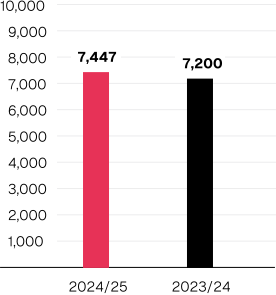
In the reporting period, the electricity grid distribution volume increased to 7,447 GWh; this is equivalent to an increase of 3.4% compared to the same period of the previous year (7,200 GWh). This increase in volumes affected both the industrial and household sectors and was facilitated by a decrease in electricity trading prices compared to the previous year. As of 30 September 2025, Netz OÖ GmbH supplied approx. 533,000 active customer installations (previous year: approx. 531,000).
In the 2024/25 fiscal year, business activities focused on grid upgrade and expansion measures with a view to maintaining and securing a stable electricity supply, the integration of decentralised generation systems and the consistent implementation of the Electricity Grid Development Plan for Transmission System Operators (V-NEP). In June 2025, the ‘Upper Austria Central Area’ project saw the commissioning of the refurbished and extended Tillysburg substation. The project is currently on schedule.
During the reporting period, operational work was carried out on connecting the power station connection for the Ebensee pumped-storage power plant, the Rottenbach substation and the Klaus grid support facility. Work on the Ottensheim Danube crossing and the Wagenham grid support facility was completed during the reporting period.
The EIA hearing for the ‘Electricity supply for Mühlviertel’ project was held in January and February 2025. The decision had not been published by the end of the reporting period. In the scope of the ‘Electricity supply for Salzkammergut’ project, the documents for the approval under high voltage electricity grid law were submitted to the Federal Ministry of Economy, Energy and Tourism, and the oral hearing with a subsequent decision is expected before the end of the 2025 calendar year. It proved possible to obtain all the required approvals for the new Putzlinsdorf substation to be built on the existing Ranna - Rohrbach line. Construction is scheduled to start in the fiscal year 2025/26 following preparations for the medium voltage grid.
Replacing of overhead power line sections of the medium and low-voltage grid with underground cable was continued. In the 2024/25 fiscal year, 20 km of medium-voltage overhead lines and 113 km of low-voltage overhead lines were replaced by underground cables. Earth cables now account for 38.0% of the medium voltage grid and 79.0% of the low voltage grid.
The number of grid connection applications for PV systems took a dynamic course in the 2024/25 fiscal year. After the federal government negotiations having lasted longer than expected, the announcement signalling the end of the VAT exemption on the purchase of PV systems early on in the 2025 calendar year was relatively unexpected. Within days, the number of requests rose abruptly from around 200 to almost 600 per week. The processing systems, set up in the past, which have already been automated to a large extent, proved resilient and it was possible to process requests without noticeable delay for customers. On average, the number of applications over the 2024/25 fiscal year was at a consistently high level of about 260 per week. In the reporting period, there was an increase in the number of applications submitted for battery storage facilities. As it was impossible to fully provide the grid capacities or grid connections required for these systems at all locations, it will be necessary to carry out additional grid construction on the medium voltage grid, and in particular at substations.
The installed output from PV is around 1,470 MW in the reporting period (previous year: 1,300 MW), with around 83,500 connected systems (previous year: 72,800 systems).
Gas grid distribution volume to end users
in GWh
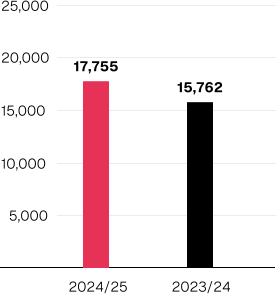
In the reporting period, the gas grid distribution volume increased to 17,755 GWh; this is equivalent to an increase of 12.6% compared to the same period of the previous year (15,762 GWh). This increase in volumes affected both the industrial and the household sectors and was facilitated by a decrease in gas trading prices compared to the previous year.
In the 2024/25 fiscal year, the number of customers in the gas sector also declined. The causes for this were trends in society and political requirements, particularly in the field of climate change mitigation.
Extensive upgrades were carried out at three reduction stations in the 2024/25 fiscal year. Two high-pressure natural gas pipelines over a total length of 8.9 km were investigated using intelligent pigging. Beyond this, various repairs to high-pressure pipelines were carried out in the reporting period.
In addition, with a focus on a future hydrogen economy, concrete preparations have been made for the dual dedication of a high pressure line, which is also part of the Austrian Network Infrastructure Plan (ÖNIP), the H2 roadmap of AGGM Austrian Gas Grid Management AG (AGGM) and the long-term and integrated planning approved by the regulator. This will enable the operation of the existing gas grid infrastructure with methane and hydrogen in the future.
During the reporting period, Netz OÖ GmbH launched a decarbonisation project network. In a first step of the project, existing CO2 emissions in the company were identified and presented in a transparent manner. Subsequently, actions to reduce emissions were explored.
The positive findings of the electromobility pilot project in network technology over a number of years have led to effective CO2 reduction actions being derived. In a pan-European request for quotations, 57 electric vehicles have now been purchased, equipping a quarter of all employees in the unit in the first step. Featuring approx. 100 kW output and a daily range of some 300 kilometres, the vehicles are optimised for daily requirements. The project will reduce the number of fossil-fuel kilometres travelled by about 500,000 kilometres per year.
A project to improve customer communication and complaints management has also been launched. This involves harmonising or standardising the complaints management process, while leveraging appropriate digitalisation opportunities. Operational implementation will take place in the 2025/26 fiscal year.