Environment Segment
|
|
Unit |
|
2024/25 |
|
2023/24 |
|
Change |
|---|---|---|---|---|---|---|---|---|
Total sales |
|
EUR mill. |
|
299.1 |
|
298.0 |
|
0.4% |
EBIT |
|
EUR mill. |
|
12.2 |
|
33.3 |
|
-63.4% |
Investments in property, plant and equipment and intangible assets |
|
EUR mill. |
|
25.5 |
|
29.6 |
|
-13.9% |
Workforce (on average) |
|
FTE |
|
848 |
|
837 |
|
1.3% |
Total waste volume handled |
|
1,000 t |
|
1,474 |
|
1,533 |
|
-3.8% |
Incinerated waste volume |
|
1,000 t |
|
577 |
|
575 |
|
0.3% |
Economic framework conditions for the waste management sector
The EU Circular Economy Package aims to make the production of sustainable products in the European Union a matter of course. The intent is to ensure that products are durable, repairable, reusable and recyclable throughout their entire life cycles. At national level, the Circular Economy Package amendment under the Waste Management Act (AWG) is intended to continue to promote the drive towards waste avoidance, recycling, and reuse, and to achieve a product design based on European eco-design specifications that is consistently geared towards sustainability. To this end, concrete targets have been defined, including for recycling rates, reusable and disposable packaging, the reduction of certain plastic products, as well as for the fields of producer responsibility, incineration bans and landfill restrictions. These actions pose significant challenges for the whole industry.
The revised EU Waste Framework Directive was published on 26 September 2025 and is due to be transposed into national law by member states within 30 months. Substantial changes have been made in the area of food and used textiles. The aim is to reduce waste from food production and processing by 10.0% by 2030. In addition, the intent is to reduce by 30.0% the average calculated food waste per capita figure, which is attributable to retail, catering and household sectors. In the case of used textiles, extended producer responsibility will be introduced. In future, manufacturers must bear the cost of collection, sorting and recycling, and encourage the production of more durable clothing, while fast-fashion products will be burdened with higher contributions in the future. These changes will create new market opportunities for Energie AG Oberösterreich Umwelt Service GmbH (Umwelt Service GmbH).
The new EU Packaging Regulation (PPWR) entered into force on 11 February 2025 and will apply as of 12 August 2026. With a phased schedule, the Regulation aims to ensure that all packaging is recyclable in future by introducing recycling classes and defining minimum recycling shares. Mandatory recycling targets of 65.0% by 2025 and 70.0% by 2030 have been set and further differentiated by fractions such as plastics, paper and glass. Packaging minimisation, producer responsibility, deposit systems and extensive information requirements are also important parts of the regulation.
On 1 January 2025, a deposit of EUR 0.25 was introduced in Austria on PET and aluminium containers with volumes between 0.1 litres (L) and 3.0 L. In order to avoid waste and ensure a sustainable circular economy, deposit quotas have also been defined for the retail trade for drinks placed on the market; they will be at least 25.0% by 2025 and at least 30.0% by 2030; the quotas apply to retail outlets with more than 400 m2 floorspace and online commerce.
The Waste Management Act amendment on digitalisation aims to drive further efficiency increases in waste management and therefore help to more quickly achieve sustainability objectives defined at a national level. The amendment focuses on measures designed to achieve a higher degree of digitalisation in waste management. Digitalised system approval procedures, central processing of deposits on non-recyclable packaging and fully electronic consignment notes are examples of this. The latter were unveiled by the BMLUK in April 2025 and are to be made mandatory by 1 January 2027. In addition to the numerous benefits the digital solution offers, major implementation overhead is anticipated at Umwelt Service GmbH.
Umwelt Service GmbH met its obligation under the AWG, to use rail or similarly climate-friendly means of transport to transport waste of more than 10 t over distances of more than 200 km during the year under review, by switching its own fleet of trucks to sustainable HVO100 (100.0% hydrotreated vegetable oil) fuel. A reduction of route lengths to 100 kilometres, originally planned as of 1 January 2026, will probably be postponed until 2030.
In the 2024/25 fiscal year, higher prices for recovered paper/carton created more favourable framework conditions compared to the previous year. In terms of metals, average prices for various types of steel scrap were lower than in the previous year.
Business development in the Environment Segment
In the 2024/25 fiscal year, sales revenues in the Environment Segment amounted to EUR 299.1 million (previous year: EUR 298.0 million), representing an increase of 0.4%. While sales growth was particularly evident among business and industrial customers, declining sales revenues from electricity generated were observed due to lower prices and volumes. Turnover from other waste disposal services increased compared to the previous year.
In the Environment Segment, the operating result in the 2024/25 fiscal year was lower than in the previous year at EUR 12.2 million. EBIT was impacted by lower earnings contributions from generated electricity volumes. In contrast, the earnings for both industrial and commercial customers improved compared to the previous year. Increased earnings were recorded for used paper/cardboard recycling materials and for scrap metal, the latter reflecting increased volumes.
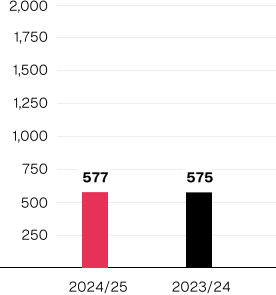
Incinerated waste volume
in 1,000 t
Utilisation of the waste incineration plants
The waste incineration plants at Wels and Lenzing achieved a throughput of about 577,000 t of incinerated waste volume. This is equivalent to an increase of 0.3% compared with the previous year. It proved possible to offset a decrease in volume throughput in Wels by higher throughput in Lenzing, as Lenzing experienced fewer unplanned plant shutdowns than the previous year.
At the Wels waste incineration plant, line 2 was overhauled in June and July 2025, and line 1 in September and October 2025. In Lenzing, the annual overhaul took place in February and March 2025.
The supply of heat mainly from the waste incineration process to the eww ag district heating network, was sustained without interruption throughout the fiscal year. Heat from solar energy and biomass are also fed into the grid. In case of downtime at the waste incineration plant and to cover short-term capacity bottlenecks, a backup system of hot water boilers is available to supply heat to the grid. This was activated in individual months in order to fully deliver the required heat.
In the reporting period, the waste incineration plant in Wels distributed 348 GWh of heat (previous year: 285 GWh) to the district heating network and to one other key account customer. Electricity procurement totalled 171 GWh (previous year: 181 GWh).
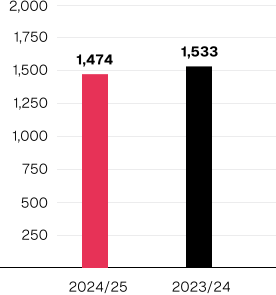
Total waste volume handled
in 1,000 t
The treatment plants for hazardous waste in Steyr were again very well utilised in the year under review. In terms of maintenance, the focus was primarily on the renovation of the chemical/physical treatment installation for non-organic waste. Important refurbishments of the roof were also carried out.
Compared with the 2023/24 fiscal year, the volumes handled in the Environment Segment fell slightly by 3.8% in the reporting period to a total of some 1,474,000 t (previous year: 1,533,000 t). While volumes in Austria declined, particularly in the mechanical biological treatment (MBT) fractions and hazardous waste, South Tyrol recorded an overall increase.
Various investment projects were implemented at the sales locations in the reporting period. In Steyr, a developed plot of land has been acquired with a view to future use for transhipment, processing and intermediate storage of non-hazardous waste. A new social building was completed at the Attnang Redlham site. In Unterhart, the final stage of the landfill expansion was completed.
In addition, Umwelt Service GmbH again participated in the call for applications for several grants for zero-emission commercial vehicles and infrastructure (ENIN). In the 2024/25 fiscal year, several electric trucks and electric charging infrastructure to match were also purchased. Further PV systems were also built and commissioned.
During the reporting period, a new tender for residual and bulky waste disposal, was jointly initiated by the Upper Austrian District Waste Associations; a consortium of bidders, including Umwelt Service GmbH, again won the contract award. This will enable the company to continue to make an important contribution to security of disposal in Upper Austria.
In the Carinthia region, a contract for the outsourcing the waste management of a large industrial customer was also secured. Since the existing site in Fürnitz has already seen steady growth in sales over the past few years and the existing areas will no longer be sufficient to handle orders in the future, Umwelt Service GmbH has made a binding offer with a view to purchasing property. A final decision by the property owner is expected in the 2025/26 fiscal year.
Since 2021, the Federal Competition Authority (BWB) has been investigating several companies in the waste management sector in Austria for potential antitrust violations. This also affects Umwelt Service GmbH. Umwelt Service GmbH is treating the matter with the utmost seriousness and is cooperating fully with the BWB with the aim of clarifying the suspicions in full. Due to the potentially negative financial impact, a provision was recognised in the current reporting period. Given the complexity of the case, it remains unclear - pending the conclusion of the proceedings - whether any financial burdens will arise and, if so, in what amount.
The economic framework conditions at the Neumarkt location was still difficult due to the depression in the construction industry and the lower demand for substitute fuels this caused. Paper turnover has stabilised slightly compared to the same period last year. Paper reject volumes again achieved good levels. While lower prices in commercial and industrial waste disposal continued, glass sorting remained stable.
WDL-WasserdienstleistungsGmbH (WDL GmbH) experienced largely stable framework conditions for drinking water supply and waste water management in Austria during the reporting period. At WDL GmbH, the main focus was on maintaining the secure supply of drinking water and further developing the services offered.