
Management of impacts, risks and opportunities
E5-1 – Concepts related to resource use and circular economy
The Energie AG Group places strong emphasis on protecting the environment as far as possible, using natural resources sparingly and employing environmentally friendly technologies.
To achieve this conservation of resources, Energie AG relies on circular economy principles such as circular design and planning, longevity, and extending the useful life of buildings, plant and equipment through maintenance, refurbishment and repair, as well as closing material loops at the end of the useful life.
In procurement, specific requirements in the procurement policy and in individual tendering procedures ensure that sustainability criteria—such as purchase price and energy efficiency—are taken into account from the outset by reducing negative environmental impacts associated with resource use. Environmental and sustainability certifications are requested when selecting and evaluating suppliers.
Already in the planning and construction of buildings and plants, great importance is attached to the most economical use of resources, while at the same time all Energie AG plants are designed for longevity. To keep materials in use for as long as possible, the life or service life of installations and components is extended through maintenance or refurbishment activities. For example, since 1908, the Steyrdurchbruch hydropower plant has been supplying environmentally friendly energy from hydroelectric power. With this sustainably operated power plant, which has been preserved through renovation measures, Energie AG is making a tangible contribution to the generation of electrical power. The original power plant was expanded in 1972 with the addition of a second plant and has since supplied electricity to around 5,700 households. The waste heat from the then newly installed generator allows the heating of both the engine rooms in the new plant and the machinery in the old building.
Through the internal reuse and recycling of refurbished meters (heat and water meters), as well as the extension of recalibration periods and the recalibration of electricity meters and, in some cases, gas meters, materials and components are kept in circulation, thereby conserving valuable primary raw materials.
In the area of IT infrastructure, responsible and resource-efficient use of equipment and materials is of particular importance to Energie AG. Once their internal useful life has expired, notebooks and personal computers are not disposed of but transferred to a specialised reprocessing company. This ensures that the equipment or its components are properly processed and reused. In this way, the life cycle of IT hardware is extended, the amount of e-waste is reduced, and an important contribution is made to resource conservation and the circular economy.
The legally compliant handling of waste and hazardous substances in the disposal sector is particularly important for closing material cycles. With its waste management and related services, Umwelt Service GmbH covers several steps within central recycling management strategies (the ‘R strategies’)—‘Recycle’ and ‘Recover’—including the production of high-quality compost, the degassing and dismantling of refrigerators, the mechanical processing of mixed waste to obtain recyclable fractions, and the generation of electricity and heat from the incineration of household and commercial waste.
A comprehensive strategy for resource use and circular economy will be developed in the following fiscal years.
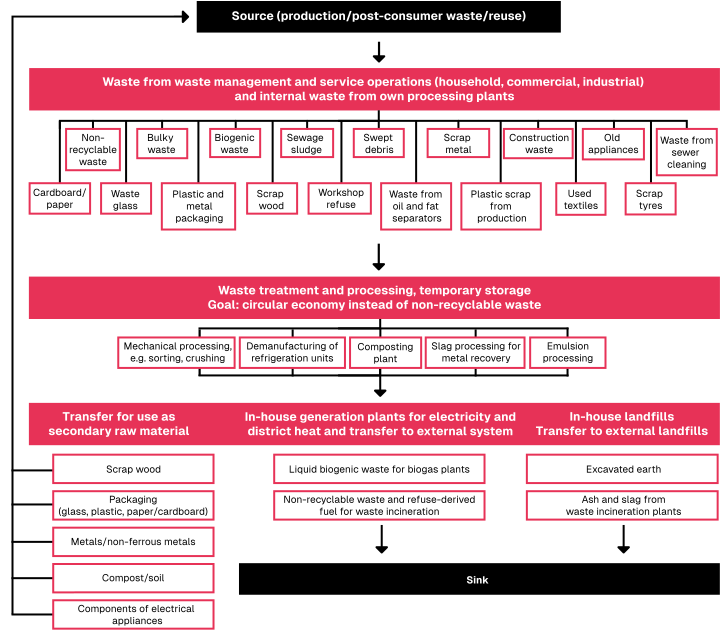
The following graphic illustrates how the Environment Segment supports the transition from a linear to a circular economy. A significant share of waste is already being recycled or reused. If recycling is not possible at the end of the product life cycle, the waste is incinerated. Soil extraction and ash and slag from waste incineration are sent to landfill in accordance with legal requirements.
E5-2 – Actions and resources related to resource use and circular economy
Network of locations and recycling partners in Austria
Resource inflows, including resource use
Action |
|
Network of locations and recycling partners in Austria |
|---|---|---|
Description |
|
Umwelt Service GmbH provides regional waste disposal services for its commercial, industrial, municipal and private customers throughout Austria. This waste management security is maintained by the company's 24 own waste management locations and a large number of recycling partners. The 24 locations are spread across Austria. The recycling partners are primarily national, but some are also international. In addition, long-term contracts have been concluded with customers, e.g. the ‘Upper Austrian waste solution’. These actions increase reliability, safety and thus customer satisfaction. |
Expected outcomes |
|
Thanks to its network of locations throughout Austria and its close cooperation with national and international recycling partners, Umwelt Service GmbH is regarded as a reliable waste disposal service provider. Customers can count on secure, comprehensive and long-term guaranteed waste management. Stable contracts and partnerships lead to increased customer satisfaction, strengthened trust and sustainable positioning of the company in the market. |
Scope of the measure |
|
Upstream and downstream value chain, own business activity |
Time horizon |
|
Ongoing implementation |
IROs on which the measure is based |
|
Resource recovery through the business activities of the Environment Segment |
Implementation progress |
|
Long-term activity |
Methodological information on monitoring implementation and effectiveness |
|
Ongoing monitoring of load utilisation, site performance and partnerships will verify security of supply. This will allow for a transparent and sustainable monitoring of the continuous, safe and reliable waste management. |
Resource conservation through mobile slag processing
Resource inflows, including resource use
Action |
|
Resource conservation through mobile slag processing |
|---|---|---|
Description |
|
At the Wels site, Umwelt Service GmbH processes the slag that remains after incineration; this is an inert, non-reactive, rock-like material that needs to be disposed of in landfill. In a multi-stage mechanical separation process, iron and non-iron content remaining in the slag after incineration is removed to the furthest extent possible. After incineration, around 250 kg of slag remains from one tonne of waste at the Wels Abfallverwertung waste incineration plant, along with other residual materials. |
Expected outcomes |
|
The raw materials (aluminium, copper, iron, steel, brass and stainless steel) can be separated from the slag, recycled and returned to the metal processing cycle. This means that there is an additional potential for savings in CO2 emissions compared to the recovery of these raw materials. In addition, the recycling of the metals reduces the annual landfill volume in Wels. |
Scope of the measure |
|
Own business activities, downstream value chain |
Time horizon |
|
Ongoing implementation |
IROs on which the measure is based |
|
Resource recovery through the business activities of the Environment Segment |
Implementation progress |
|
Long-term activity |
Methodological information on monitoring implementation and effectiveness |
|
The effectiveness of the measure is ensured by annually recording and documenting the quantities of slag processed. This allows transparent monitoring of both the continuous improvement of the process and the environmental benefits. |
Sustainable plastics processing
Resource inflows, including resource use
Action |
|
Sustainable plastics processing |
|---|---|---|
Description |
|
Plastic windows have been recycled at the Ötztal site since the beginning of 2021. This means that scrap iron, metals and PVC can be separated by type and then returned to the industrial cycle in an environmentally friendly way. |
Expected outcomes |
|
Processing at the Ötztal site has allowed 371,830 kg (previous year: 295,080 kg) of plastic windows, doors and roller shutters as well as sections of profiles to be passed on for material processing in the 2024 calendar year. This resulted in total savings of 590,838 kg CO2e in the 2024 calendar year (previous year: 468,882 kg CO2e). |
Scope of the measure |
|
Own business |
Time horizon |
|
Ongoing implementation |
IROs on which the measure is based |
|
Resource recovery through the business activities of the Environment Segment |
Implementation progress |
|
Long-term activity |
Methodological information on monitoring implementation and effectiveness |
|
The annual collection and documentation of the processed volumes and the CO2 savings obtained are shared in an annual report by Dekura GmbH. By comparing the figures with those from the previous year, the continuous improvement and ecological benefits of the measure become clearly transparent. |
Recycling plant for refrigeration units
Resource inflows, including resource use
Action |
|
Recycling plant for refrigeration units |
|---|---|---|
Description |
|
Since 2003, together with a partner, Umwelt Service GmbH has been operating one of two stationary processing and recycling plants for disused refrigeration units in Austria at the site in Timelkam. Nationwide, around 300,000 refrigeration units are recycled annually (120,000 of which in Timelkam) and the valuable materials extracted therefrom resupplied to the production cycle. In the procedure used, the refrigerant which contains CFCs and is harmful to the environment is first removed in two stages and then the four main components (iron and steel scrap, mixed plastic fraction, compressors and PUR powder) for recycling extracted. Iron and steel scrap, compressors and the mixed plastics fraction are subsequently used as raw materials, for example in the plastics and steel industries. The recovered and degassed PUR powder is handed over to a partner who processes it into oil-binding agents for use by fire brigades, workshops and filling stations. By destroying ozone-depleting substances (ODS) and recycling secondary raw materials, 33,131 tonnes of CO2 were saved in the 2024 calendar year. |
Expected outcomes |
|
In total, over 94% of the components of a refrigeration unit are supplied to the recovery and recycling process. |
Scope of the measure |
|
Upstream and downstream value chain, own business activity |
Time horizon |
|
Ongoing implementation since 2003 |
IROs on which the measure is based |
|
Resource recovery through the business activities of the Environment Segment |
Implementation progress |
|
Long-term activity since 2003 |
Methodological information on monitoring implementation and effectiveness |
|
The annual recording of the processed volumes ensures transparent tracking of continuous improvements and the environmental benefits of the measure. |