
Macroeconomic environment 1)
The 2024/25 fiscal year (1 October 2024 to 30 September 2025) of Energie AG Oberösterreich (Energie AG) saw the Austrian economy only slowly recover from the recession; the economy has been growing since then, while inflation remains high. The economic upswing was triggered by private consumption, while external trade in goods contracted initially.
Economic growth and inflation
YoY real change (in %)
Sources: IHS, IMF, WIFO
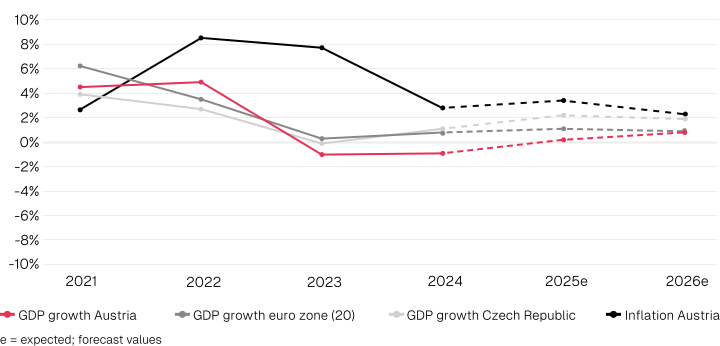
Using the gross domestic product (GDP) as a measure, the Institute for Advanced Studies (IHS), the Austrian Institute of Economic Research (WIFO) and the International Monetary Fund (IMF) expect slight growth of +0.3% (previous year: -0.8%) for the Austrian economy for the calendar year 2025. This moderate GDP growth is mainly driven by private consumption, which has proven to be a key factor in the economic recovery, despite global uncertainties. Low international demand for capital goods is weighing heavily on domestic exporters. Beyond this, weak financial performance exhibited by companies has impacted on their willingness to invest. US import tariffs are also impeding progress, particularly because the US has been a significant outlet for Austrian goods in recent years. The labour market is still in the throes of recession. Inflation is expected to be higher than anticipated and is forecast at 3.5% for the 2025 calendar year (previous year: 2.9%).
Economic growth for the euro zone is expected to be +1.3% and +1.2% respectively for 2025 by the IHS and WIFO economic institutes and the IMF (previous year: +0.9%).
In the Czech Republic market relevant to Energie AG, an increase in economic output in the order of around +2.3% is anticipated for the 2025 calendar year (previous year: +1.2%). Growth is therefore expected to be above the euro zone average.
1)
1)
Sources: IHS (Institute for Advanced Studies): Autumn Forecast for the Austrian Economy, 2025–2026 (ihs.ac.at), 8 October 2025.
IMF (International Monetary Fund): World Economic Outlook Database: October 2025 (imf.org), 15 October 2025.
WIFO (Austrian Institute of Economic Research): WIFO Economic Data (wifo.ac.at), 8 October 2025.