
Management of impacts, risks and opportunities
E1-2 – Concepts related to climate change mitigation and adaptation
Concept for expanding renewable energy generation
Climate change adaptation, climate change mitigation, energy; access to products and services
Content: The ‘LOOP’ strategy and organisation project (see SBM-1 – Strategy, business model and value chain) is focused on the comprehensive decarbonisation of the Group’s core business activities and on advancing environmentally sustainable business operations, while ensuring security of supply and waste management in each case.
Overall objectives: The ambitious expansion of electricity and heat generation from renewable sources is intended to ensure the gradual reduction of the Group’s greenhouse gas emissions.
Material impacts, risks and opportunities:
Climate change adaptation |
||
|---|---|---|
Material positive impacts |
|
|
Material risks |
|
|
Climate change mitigation |
||
Material positive impacts |
|
|
Material negative impacts |
|
|
Material opportunities |
|
|
Material risks |
|
|
Energy |
||
Material positive impacts |
|
|
Material opportunities |
|
|
Social inclusion of consumers and/or end-users – Access to products and services |
||
Material positive impacts |
|
|
Monitoring processes: Quarterly steering committee meetings, regular reporting and dashboards are set up to ensure that the strategic climate change mitigation targets are met and that corrective action can be taken if there are any deviations from the targets.
The renewable production concept takes account of climate change mitigation, climate change adaptation, energy efficiency and the use of renewable energies.
Scope: The policy applies to all units of the Energie AG Group and therefore covers all business activities.
Upstream value chain: The upstream value chain includes the purchase of raw materials and goods, the extraction of renewable resources and the procurement of services in the Energy Segment. The strategy project covers targets for the procurement of resource-efficient modes of transport and the purchase of raw and recyclable materials in the Waste Management Segment.
Downstream value chain: In terms of the downstream value chain, the concept primarily addresses targets to support energy-efficient and sustainable customer behaviour. In addition to expanding district heating, replacing fossil-fuelled heating systems with decarbonised on-site heating purchase agreements and promoting the installation of heat pumps and PV systems for sales customers is also being strongly pursued.
Geographical areas: The main geographical focus is on the core business areas of Austria and the Czech Republic, with a growing strategic focus on business activities for energy generation from renewable sources in the neighbouring countries of Germany, Italy and Slovenia.
Responsibilities: The Management Board and the managing directors of the Group companies
Standards and third-party initiatives: Energie AG expressly supports policy targets to expand the use of renewable energy and reduce the use of fossil fuels. The legal basis is in place at the European level, for example in the Fit for 55 legislative initiatives, and at the national level, including the Austrian Renewable Energy Expansion Act package.
Stakeholder involvement: In developing and implementing the strategy, particular emphasis was placed on ensuring a high degree of transparency in communication and on involving all employees and taking their interests into account. This is reflected in the participation of employees from different hierarchical levels in the Group’s internal expert teams for strategy development, the regular dialogue between the Management Board, project management and the Works Council, the employee information events, and the associated change and culture project, which incorporated employee expectations and needs throughout both the analysis and implementation phases. This approach was intended to secure the broadest possible alignment on the shared strategic direction, with a strong focus on decarbonisation. In the 2024/25 fiscal year, a Sustainability Action Day was held, inviting all employees to develop environmentally sustainable ideas and concepts. Particular importance was attached to involving citizens during the implementation of the concept, for example through information events.
Implementation support: After the resolution was passed, the most material key elements of the strategy were announced publicly and published in the 2022/23 Group Annual Report so that stakeholders who are either directly or potentially affected can learn about the strategic plans.
Climate change mitigation through sales
Climate change adaptation; climate change mitigation; energy
Content: For the purposes of the overarching corporate orientation, CO2 emissions are also to be reduced along the entire value chain within Vertrieb GmbH. The focus lies on supporting customers in their transition to sustainable energy solutions and thereby reducing Scope 3 emissions. This will be achieved by offering energy efficiency improvements to customers in the domestic market, decarbonisation solutions in the heating sector (direct decarbonisation effect), and measures to increase the share of renewable electricity supplied (indirect decarbonisation effect).
Material impacts, risks and opportunities:
Climate change adaptation |
||
|---|---|---|
Material positive impacts |
|
|
Climate change mitigation |
||
Material positive impacts |
|
|
Material negative impacts |
|
|
Material opportunities |
|
|
Material risks |
|
|
Energy |
||
Material positive impacts |
|
|
Material negative impacts |
|
|
Material opportunities |
|
|
Monitoring processes: In addition to regular project screenings and divisional reporting, progress on defined decarbonisation action areas is reported to the Management Board on a quarterly basis.
Scope: By implementing the sales-related climate protection strategy, Vertrieb GmbH makes a measurable contribution to achieving the climate objectives of Energie AG. Through both direct and indirect decarbonisation measures, a holistic reduction of greenhouse gas emissions is achieved.
The strategy applies throughout Austria; for measures and products developed in cooperation with market partners, the scope is limited to Upper Austria.
Upstream and downstream value chain: The value chain encompasses the procurement of electricity and guarantees of origin from 100% renewable sources, support for self-generation (e.g. PV systems) and grid feed-in, the expansion of renewable heat solutions, and energy savings achieved through incentive schemes, tailored offers and advisory services.
Geographical areas: The strategic orientation covers the Austrian energy sales market and energy services, with a particular focus on Upper Austria.
Responsibilities: The Management Board and the managing directors of Vertrieb GmbH
Third-party standards and initiatives: Energie AG supports statutory provisions and incentive schemes designed to promote renewable energy (e.g. the use of heat pumps) and to increase energy efficiency (e.g. the Federal Energy Efficiency Act). In addition, partnerships and collaborations will be strengthened to support end users in saving energy and in achieving the highest possible level of decarbonisation. Vertrieb GmbH also relies on certification to demonstrate the sustainability of its products, such as the IP46 certificate in the electricity sector.
Stakeholder involvement: Vertrieb GmbH engages relevant stakeholders at multiple levels throughout its strategy and product development processes. In a joint process with the employees of Vertrieb GmbH, the strategic objectives for expanding sustainable customer solutions were developed and defined in detail. These central objectives were then communicated openly and transparently. In addition to internal organisational units and employees, cooperation partners and end users are regularly involved through market research. In the business customer segment, ongoing consultations with the Chamber of Commerce are conducted to validate and adjust new offerings at an early stage, particularly in the area of decarbonisation. Continuous dialogue between customer advisors and corporate clients ensures that current market needs and feedback are systematically integrated into the ongoing development of products and services.
E-mobility concepts
Climate change adaptation; climate change mitigation; energy
Content: In the 2019/20 fiscal year, a decision was taken to realign the Group’s internal e-mobility strategy in order to prioritise this area. The resulting initiatives in the field of e-mobility have now been fully implemented (see E1-3 – Actions and resources related to the climate concepts), and have also contributed to a reduction in CO2 emissions. As part of the ‘LOOP’ strategy and organisation project (see SBM-1 Strategy, business model and value chain), certain actions – such as the expansion of public electric vehicle charging infrastructure and related service offerings – were reassessed, and several targets were revised. In the 2024/25 fiscal year, the Group increased its level of ambition for further electrification of its internal vehicle fleet (see E1-3 – Measures and resources related to climate concepts) and consequently set an internal decarbonisation target for its Austrian vehicle fleets (see E1-4 – Targets relating to climate change mitigation and climate change adaptation).
General objectives: The strategic objectives include the gradual conversion of the company fleet to electric vehicles, the expansion of service offerings for customers and the accelerated roll-out of electric vehicle charging infrastructure. The goal is to fully electrify the Austrian car fleet by 2030.
Material impacts, risks and opportunities:
Climate change adaptation |
||
|---|---|---|
Material positive impacts |
|
|
Climate change mitigation |
||
Material positive impacts |
|
|
Material negative impacts |
|
|
Material opportunities |
|
|
Material risks |
|
|
Energy |
||
Material negative impacts |
|
|
Monitoring processes: A quarterly report is presented to the Management Board on the progress of the identified action areas, allowing corrective action to be introduced if necessary.
The e-mobility concept takes into account the areas of climate change mitigation, adaptation to climate change and the use of renewable energies.
Scope: The policies cover the e-mobility sector in Austria, which means that all segments are included, with the exception of the Czech Republic segment.
Upstream and downstream value chain: In the upstream value chain, the focus is on the procurement of electric cars for the company vehicle fleet and charging station infrastructure; in the downstream value chain, the focus is on the sale of electricity to customers.
Geographic areas: The geographic area covered by the policy includes company divisions and locations throughout Austria, with a focus on Upper Austria.
Responsibilities: The Management Board and the managing directors of the Group companies
Standards and third-party initiatives: Energie AG expressly supports policy objectives aimed at expanding the use of e-mobility and reducing the reliance on fossil fuels in transport, and endorses state and federal subsidy schemes that incentivise sustainable mobility. Energie AG has not committed to any external standards in the implementation of its e-mobility strategy.
Stakeholder involvement: During the policy analysis and development process, the opinions and needs of the relevant Group units and their employees were gathered and incorporated when defining the strategic direction. The progress of the strategy actions, such as expanding the range of services for customers, was published at regular intervals on the company website for potentially affected stakeholders under Electromobility: Green Driving Made Easy with Energie AG.
Expansion of grid infrastructure
Climate change mitigation, energy; access to products and services
Content: Netz OÖ GmbH considers itself an enabler of a sustainable energy future. By expanding and upgrading the low-, medium- and high-voltage grid as well as preparing the gas grid for the transportation of green hydrogen, energy will be reliably distributed in a future renewable energy system.
General objectives: Netz OÖ GmbH's highest priority is to provide customers with a long-term and reliable energy supply. A total of EUR 2.0 billion will be invested in projects across the different electricity grid voltage levels by 2035 in order to guarantee this.
Material impacts, risks and opportunities:
Climate change mitigation |
||
|---|---|---|
Material positive impacts |
|
|
Material opportunities |
|
|
Material risks |
|
|
Energy |
||
Material positive impacts |
|
|
Material negative impacts |
|
|
Material opportunities |
|
|
Social inclusion of consumers and/or end-users – Access to products and services |
||
Material positive impacts |
|
|
Monitoring processes: Projects are monitored continuously to ensure that expansion projects can be implemented on time. Netz OÖ GmbH's ambitious investment targets require optimal technical and economic conditions, but are also influenced greatly by the statutory and regulatory environment. However, protracted approval procedures – electricity grid projects are usually not comparable to the expansion of power generation plants – could mean that the company's internal targets and the Austrian national climate protection targets cannot be met on time.
Climate change mitigation and the use of renewable energy: The rapid expansion of – particularly decentralised – sustainable energy generation plants is also increasing the need for additional electricity grid infrastructure in order to distribute energy efficiently. The expansion of the electricity grid is therefore a fundamental prerequisite for both the company's own initiatives and national climate change mitigation efforts. Netz OÖ GmbH is proactively working on the possible future expansion or reallocation of parts of the existing high-pressure gas grid to hydrogen. According to the ‘AGGM H2 Roadmap’, a significant share of the grid should be converted or expanded to pure hydrogen transport by 2030. In some cases, replacement grids will have to be constructed to supply existing natural gas customers. Currently, it is still unclear how the hydrogen grid will be designed in detail, particularly with regard to regulation and funding, as the national implementation of the EU gas and hydrogen package is still pending. Despite this, smaller quantities of hydrogen are already being fed into the grid in accordance with existing regulations.
Scope: The expansion of the grid infrastructure aims to ensure nationwide coverage in Austria, taking into account the increasing demand for electricity. At the same time, grid construction projects are being carried out on behalf of corporate and private customers. The high-level grid expansion projects currently planned by Netz OÖ GmbH are communicated through the 2024 Distribution Grid Development Plan, which replaces the previously applicable Upper Austria Electricity Grid Master Plan.
Upstream and downstream value chain: The upstream value chain involves in particular procuring components for power lines, substations and transformer stations. The downstream value chain includes current grid operations and monitoring as well as regular inspections and repairs. In addition, the downstream value chain covers managing grid loads, ensuring grid stability and the ongoing integration of renewable energy.
Geographic areas: Netz OÖ GmbH's supply area covers the majority of Upper Austria as well as parts of Lower Austria, Salzburg and Styria. Netz OÖ GmbH supplies close to 600,000 electricity and gas grid customers.
Responsibilities: Management of Netz OÖ GmbH
Standards and third-party initiatives: Netz OÖ GmbH is aware of its social responsibility and demonstrates this by being certified in accordance with international standards, such as the ‘ONR 192500:2011’ CSR certification in the area of sustainability.
Stakeholder involvement: Stakeholders are informed of the current status of ongoing electricity supply projects through a range of communication channels. Separate web pages containing the most relevant project details have been created for the most important electricity supply projects (see, for example, Stromversorgung Zentralraum Oberösterreich – Hochspannungsblog); a podcast keeps listeners informed on electricity supply in general and, in particular, on the progress of various network expansion projects (see Der HochspannungsPodcast). In addition, updates on project progress are published regularly on the LinkedIn platform. The guidelines for planning processes relating to the routing of new high-voltage power lines were developed in 2017 in order to prevent conflicts with neighbouring residents during grid expansion projects - particularly with regard to the planned routing of 110 kV high-voltage lines; these guidelines were applied for the first time as part of the Mühlviertel power supply project in 2017 and 2018. Emulating the proven route planning process in civil engineering, these guidelines assure that the objectively best possible route is identified from a broad interdisciplinary perspective on the basis of established fundamental principles.
Real estate policy
Climate change adaptation, climate change mitigation, energy; access to products and services
Content: In the 2023/24 fiscal year, a real estate policy was adopted with a strong focus on sustainability in the area of building management.
General objectives: Enhancing energy efficiency and advancing decarbonisation in real estate management are core strategic objectives (see E1-3 – Actions and resources related to the climate concepts).
Material impacts, risks and opportunities:
Climate change adaptation |
||
|---|---|---|
Material positive impacts |
|
|
Climate change mitigation |
||
Material positive impacts |
|
|
Energy |
||
Material positive impacts |
|
|
Material negative impacts |
|
|
Material opportunities |
|
|
Social inclusion of consumers and/or end-users – Access to products and services |
||
Material positive impacts |
|
|
Monitoring processes: A regular deviation analysis is used to check whether the defined sustainable building management actions are being implemented as planned, on time and with the expected potential for decarbonisation and energy savings.
Climate change mitigation: The sustainability objectives defined as part of the policy represent key elements of the real estate policy developed in the 2023/24 fiscal year. The strategy is therefore in line with European and national efforts to reduce greenhouse gases in the property sector. The real estate policy addresses this essential development in terms of climate change mitigation and lists specific actions to promote sustainable building management (see E1-3 – Actions and resources related to the climate concepts).
Climate change adaptation: the design of new sites is adapted to weather extremes such as flooding, earthquakes or extreme summer heat.
Energy efficiency: The policy sets targets that require a reduction in the use of energy in the construction and use of real estate and in energy consumption, as well as the more efficient use of energy. To this end, actions required to achieve the strategic targets have been defined until the 2027/28 fiscal year (see E1-3 – Actions and resources related to the climate concepts).
Use of renewable energy: As part of the policy, the expansion of PV systems at the site of the managed properties is being addressed. These individual measures help ensure that a higher share of sustainable electricity can be generated and consumed directly on site. In addition to measures that do not have a direct decarbonisation effect – because electricity is already sourced exclusively from sustainable energy – ongoing measures with a direct decarbonisation impact, such as the replacement of heating systems, are being implemented continuously.
Scope: The policy applies to all buildings managed by the central property management organisational unit in Austria. It excludes the Environment Segment and the Czech Republic Segment, where separate sustainable building management initiatives are being pursued, as well as the Group’s power plant and grid infrastructure properties.
Upstream value chain: The upstream value chain includes the procurement of raw materials and goods, the extraction of renewable resources and the acquisition of services.
Downstream value chain: The installation of e-charging infrastructure at company sites, which is also available to customers, is addressed under E1-3 – Actions and resources related to the climate concepts, Sustainable mobility, and aims to promote acceptance of this sustainable form of mobility and further enhance customer convenience. This has an indirect decarbonisation effect.
Geographic area: The policy applies to the buildings managed by the central property management organisational unit in Austria. This includes around 160 properties, most of which are located in Upper Austria, with a smaller number situated in Salzburg and Styria.
Responsibilities: The Management Board and managing directors of Services und Digital Solutions GmbH
Standards and third-party initiatives: Energie AG expressly supports policy targets to expand the use of renewable energy and reduce the use of fossil fuels. The legal framework exists at both the European level - for example in the Fit for 55 legislative initiatives - and at the national level. Energie AG is guided by the Austrian Federal Ministry for Climate Action, Environment, Energy, Mobility, Innovation and Technology's ‘klimaaktiv’ (climate active) standards for new buildings, conversions and extensions. The minimum requirement for all new buildings was set at the silver building standard.
Stakeholder involvement: During the process of defining the actions to be taken, the views and needs of the affected organisational units and future customers were proactively taken into account. The real estate strategy is made available to all employees via the intranet.
E1-3 – Actions and resources related to the climate concepts
Energie AG is implementing a wide range of specific measures to achieve its sustainability ambitions. The most important of these measures are outlined in the following sub-sections. The formal basis for the various actions across the different business areas is provided primarily, but not exclusively, of the concepts and corporate strategies described above (see E1-2 – Concepts related to climate change mitigation and adaptation).
Energy storage facilities
Energy; access to products and services
Action |
|
Energy storage facilities |
|---|---|---|
Description |
|
To compensate for the volatility of electricity generation from sun and wind as part of a renewable future, industrial-scale storage capacity and flexibility is required. The transformation of the energy system is to be ensured by the implementation of pumped storage and large-scale battery storage projects. |
Expected outcomes |
|
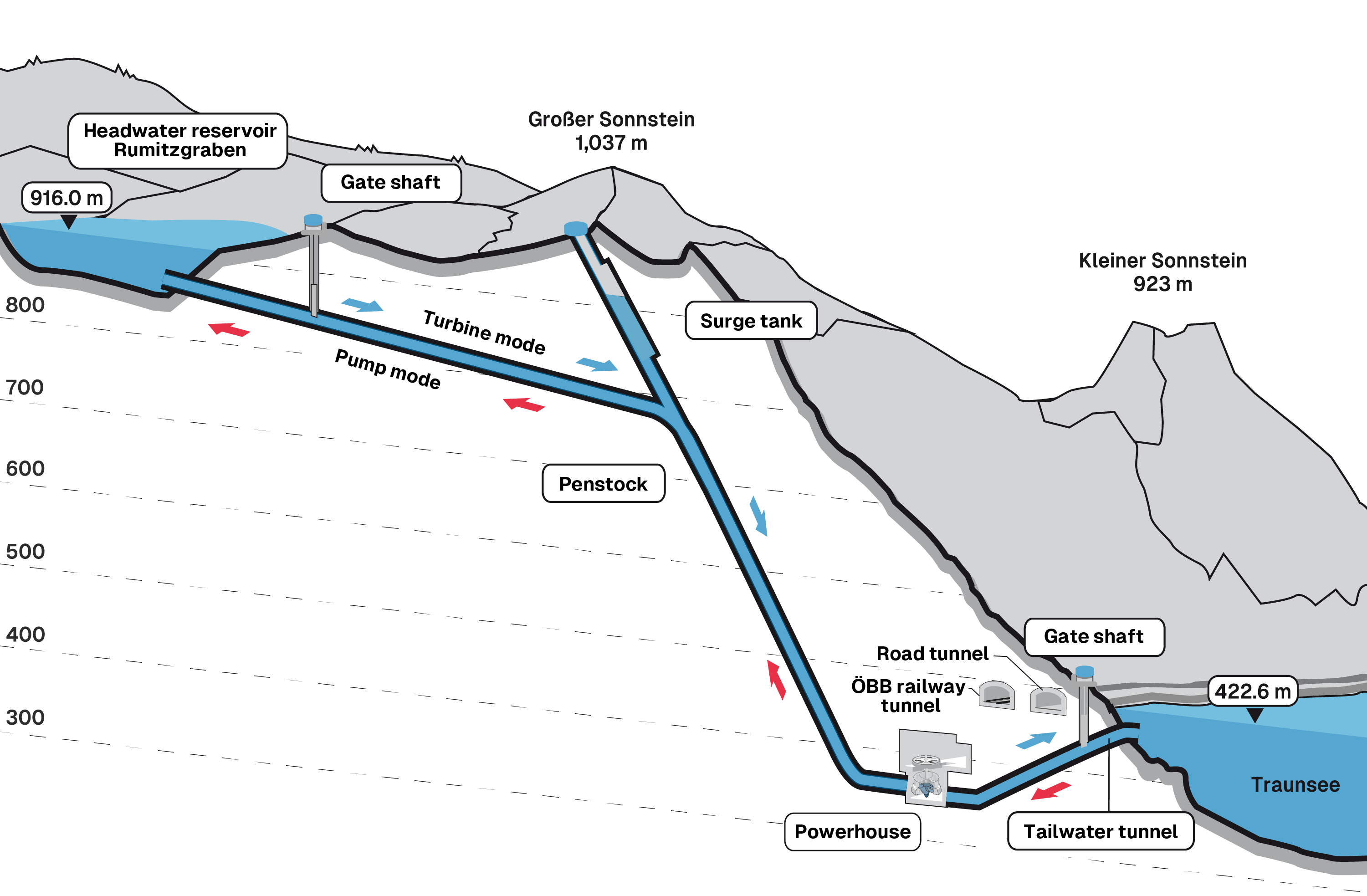
Ebensee pumped-storage power station, which is being built, has a storage capacity of 1.32 million m3 and has a capacity of 170 MW. This means the operating time to generate electricity will be 10 full-load hours. By responding to changes in demand and electricity generation with speed and flexibility, the power plant will deliver a major contribution to security of supply. With an investment volume of some EUR 450 million, this project is the largest single investment in the history of Energie AG. The European Investment Bank (EIB) is lending EUR 320 million in investment. for the construction of the pumped-storage power plant in Ebensee. In July 2025, the decision was made to build a battery storage device (15 MWh) at the Timelkam plant. The objective is to optimise storage operations. |
Concept mapping |
|
Concept for expanding renewable energy generation, security of supply and waste management |
Scope of the measure |
|
Own business |
Time horizon |
|
Construction work on the Ebensee pumped-storage power plant started in October 2023. The completion of the pumped-storage plant is scheduled for the end of calendar year 2028. The construction and completion of the battery storage facility at Timelkam plant is scheduled for the 2025/26 fiscal year. |
IROs on which the measure is based |
|
Increased production and storage of energy from renewable energy generation installations, energy security/independence, diversity of production methods (water, PV, wind power); high security of supply, resilience to crises |
Implementation progress |
|
In the 2024/25 fiscal year, significant milestones were achieved, such as the completion of the access tunnels, the ramp tunnels to the cavern and the breakthrough of the energy discharge tunnel. |
Methodological information on monitoring implementation and effectiveness |
|
The effectiveness of the actions and initiatives is reviewed regularly as part of the ‘LOOP’ strategy process and medium-term planning. Project committees etc. are held regularly. Close cooperation with project partners, construction companies, residents, universities and professional associations for the further development and structural assessment of storage capacities is ongoing. |
Pumped-storage power plant Ebensee
Renewable electricity
Climate change mitigation, energy; impacts and dependencies on ecosystem services
Action |
|
Renewable energy |
|---|---|---|
Description |
|
Energie AG has a strong focus on increasing electricity generation from renewable energy sources. This will make a material contribution to national and European energy targets and to meeting the growing demand for electricity. The focus is on generation technologies, in particular photovoltaics, wind power and hydroelectric power. |
Expected outcomes |
|
The share of electricity produced from renewable sources is expected to increase by more than 1 TWh by 2035 through individual generation projects, increasing the current level by 40%. All Group companies and subsidiaries are included in this calculation. |
Concept mapping |
|
Concept for expanding renewable energy generation |
Scope of the measure |
|
Full value chain |
Time horizon |
|
PV: In the 2024/25 fiscal year, two new agrivoltaic systems (5.5 GWh of annual electricity production p.a.) were put into service in Upper Austria. |
IROs on which the measure is based |
|
Expansion of renewable energy generation and storage facilities, negative effects from CO2 emissions, pricing CO2, decarbonisation costs, expansion of existing business areas, increased energy production from renewable generating facilities, energy security/independence, diversity of production methods (water, PV, wind power), higher water level in winter months |
Implementation progress |
|
The expansion of installed PV capacity is proceeding as planned. The projects mentioned are on schedule for implementation in accordance with the planned expansion plan. The two wind projects mentioned are currently in the approval phase. |
Methodological information on monitoring implementation and effectiveness |
|
A reporting system was established as part of the ‘LOOP’ strategy and organisation project, enabling continuous tracking of progress in expanding electricity generation from renewable sources. The aim of this monitoring tool is to detect deviations at an early stage and to initiate targeted countermeasures where necessary. |
Sustainable heat generation
Climate change mitigation, energy; access to products and services
Action |
|
Sustainable heat generation |
|---|---|---|
Description |
|
The expansion of sustainable heat generation plays a central role in the company's current strategic orientation. The objective is to replace fossil primary energy sources to the greatest extent possible with sustainable energy sources, such as biomass, industrial waste heat or process heat. |
Expected outcomes |
|
By 2035, the production of high-quality district heating is expected to increase by more than 290 GWh in all Group units. |
Concept mapping |
|
Concept for expanding renewable energy generation, security of supply and waste management |
Scope of the measure |
|
Full value chain |
Time horizon |
|
The increasing utilisation of waste heat from the Welser Abfallverwertungsanlage (WAV) as part of a district heating project in Wels is expected to raise the city’s heat off-take from 180 GWh in financial year 2020/21 to 390 GWh by 2030. As of 30.09.2025, district heating supply amounted to 329 GWh. The installation of biomass boilers as part of district heating network optimisations or expansions not only increases the relative proportion of sustainable energy sources used for heat generation, but also partially substitutes natural gas as a primary energy source. Concrete examples include the commissioning of the 5 MW biomass plant in Riedersbach and the 2.5 MW biomass plant in Freistadt in September 2025. In addition, a new 10 MW biomass heating plant in Steyr has been commissioned, in which Energie AG holds a 49% interest through BioEnergie Steyr GmbH. The biomass boiler was put into operation in the 2024/25 fiscal year and contributes significantly to the sustainable district heating supply in the Steyr area. Decarbonisation in the heating sector is also supported by the construction of a biomass boiler in Dobris (300 kW). The project, like another biomass boiler at Rokycany (800 kW) in the Czech Republic, will be put into operation in the 2025/26 fiscal year. |
IROs on which the measure is based |
|
Increased energy production from renewable energy generation plants, diversity of generation methods (water, PV, wind power), expansion of existing business areas, energy security/independence; high security of supply |
Implementation progress |
|
There are district heating projects under construction in the implementation timetable, and further heat supply projects are in different phases of design or approval. |
Methodological information on monitoring implementation and effectiveness |
|
The ‘LOOP’ strategy and organisation project established a reporting system that allows continuous monitoring of progress in the development of sustainable heat production. The aim of this monitoring tool is to detect deviations at an early stage and to initiate targeted countermeasures where necessary. There are also regular project committee meetings. |
Climate change mitigation through sales
Climate change mitigation, energy; access to products and services
Action |
|
Climate change mitigation through sales |
|---|---|---|
Description |
|
Energie AG wishes to offer its household and commercial customers the best possible support in developing environmentally friendly energy systems and is therefore focusing on expanding its own sustainable product and service offerings. The focus is on sales measures in the fields of heating, electricity and services. |
Expected outcomes |
|
The individual measures are intended to gradually reduce the use of fossil fuels, particularly in the heating sector, and increase the share of renewables in energy supply. |
Concept mapping |
|
Climate change mitigation through sales, concept for expanding renewable energy generation |
Scope of the measure |
|
Full value chain |
Time horizon |
|
Heat: In Freistadt, after successfully completed district heating network expansion, about 6 GWh more sustainable heat is to be sold each year from the fiscal year 2025/26. The densification of the district heating networks in Steyr and Riedersbach will enable sustainable heat sales to be increased by a total of up to 35 GWh p.a. – up to 25 GWh p.a. in Riedersbach and up to 10 GWh p.a. in Steyr. In addition, Vertrieb GmbH is driving forward the continuous transition from on-site power purchase agreement heating plants powered by fossil fuels to decarbonised plants. The ‘Raus aus Öl’ (Away from Oil) campaign (renamed ‘Förderbonus’ (Subsidy Bonus) on 01.03.2025) is also contributing to the replacement of fossil fuels in the heating sector and has been extended until 31.03.2026. In addition, a CO2 reduced gas product is available, to which biogas from the Engerwitzdorf biogas plant is added. |
IROs on which the measure is based |
|
Negative effects due to CO2 emissions, expansion of existing business areas, energy security/independence; high security of supply |
Implementation progress |
|
In the 2024/25 fiscal year, Vertrieb GmbH subsidised the use of 666 heat pumps. This represents a slight increase of 1.1% compared to the previous year, with a significant increase of 22.1% recorded in the area of heat pump subsidies in unrenovated buildings. Converting from oil heating to a heat pump powered by CO2–free electricity already results in average CO2 savings of 7 to per household per year. Since fiscal year 2020/21, financial support has been provided for the conversion to a total of 1,630 sustainable heat pumps. In the 2024/25 fiscal year, the contractually installed capacity of on-site heat purchase agreement systems powered by fossil fuels was reduced by 3.1 MW, while the capacity of decarbonised systems was increased by 2.6 MW. The biomethane plant in Engerwitzdorf supplied around 10 GWh (previous year: 11.2 GWh) of biomethane into the grid in the 2024/25 fiscal year. |
Methodological information on monitoring implementation and effectiveness |
|
The ‘LOOP’ strategy and organisation project has established a reporting system to ensure continuous follow-up of progress in the expansion of sales-related climate protection measures. The aim of this monitoring tool is to detect deviations at an early stage and to initiate targeted countermeasures where necessary. |
Company-specific metric
|
|
2024/25 |
|
2023/24 |
|
Comparison |
|||
|---|---|---|---|---|---|---|---|---|---|
New buildings |
|
21 |
|
52 |
|
-59.6 |
|||
Renovated older buildings |
|
118 |
|
118 |
|
0.0 |
|||
Unrenovated older buildings |
|
508 |
|
416 |
|
22.1 |
|||
Replacement of domestic hot water heat pump |
|
19 |
|
74 |
|
-74.3 |
|||
Förderbonus (Subsidy Bonus) |
|
106 |
|
0 |
|
– |
|||
Total |
|
772 |
|
660 |
|
17.0 |
|||
|
|||||||||
Product disclosure
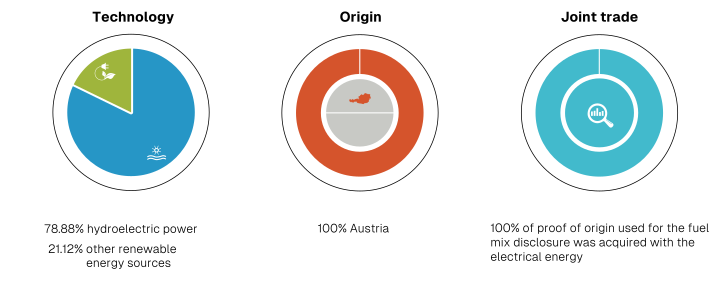
Product ‘Hydroelectric power’ 01-2024 to 12-2024 Energie AG Oberösterreich Vertrieb GmbH
Electricity labelling
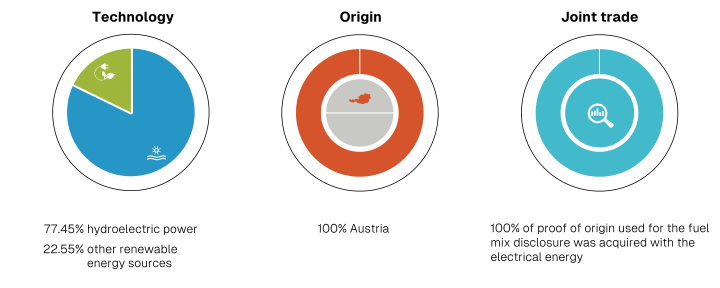
Energy mix 01-2024 to 12-2024 Energie AG Oberösterreich Vertrieb GmbH
Sustainable mobility
Climate change mitigation, energy; access to products and services
Action |
|
Sustainable mobility |
|---|---|---|
Description |
|
The sustainable mobility initiative includes further expansion of electric vehicle charging infrastructure and the expansion of services for customers. The conversion of the company's internal vehicle fleet is particularly relevant as a direct decarbonisation lever for low-carbon solutions at the Scope 1-level. |
Expected outcomes |
|
Direct decarbonisation effect: By consistently continuing to decarbonise the vehicle fleet, Scope 1 greenhouse gas emissions can be sustainably reduced. The measures include the use of biogenic fuels (HVO100) as well as the gradual electrification of the vehicle fleet, particularly passenger cars. The switch to HVO100 in more than 400 diesel cars - including 235 trucks in the Environment Segment - since the second half of the fiscal year 2023/24 results in an annual CO2 reduction potential of more than 10,000 to. Since early 2025, the operational filling station in Gmunden has also been supplied with HVO100, further contributing to the reduction of greenhouse gas emissions. Energie AG aims to operate an entirely electrified passenger car fleet in Austria by 2030 (see E1-4 - Targets related to climate change mitigation and adaptation). This will provide an additional annual decarbonisation effect of more than 300 to of CO2 per year. In addition, 57 electric vehicles in the light commercial vehicle category were added to the Netz OÖ GmbH vehicle fleet, which is expected to result in CO2 savings of around 100 to per year. Furthermore, Energie AG supports its employees in switching to public transport. Since the 2023/24 fiscal year, employees have been granted a financial subsidy of 80% of the Upper Austrian regional ‘Klimaticket’ rail pass. This will provide an incentive to move away from fossil-fuelled cars and result in a positive decarbonisation effect at Scope 3 level. |
Concept mapping |
|
E-mobility concepts, security of supply and waste management |
Scope of the measure |
|
Full value chain |
Time horizon |
|
The complete electrification of the passenger car fleet in Austria is scheduled to be completed by 2030. The further decarbonisation of the group-wide fleet of more than 1,900 vehicles are being consistently pursued. Measures to expand the charging infrastructure are being continuously driven forward. |
IROs on which the measure is based |
|
Negative effects due to CO2 emissions, expansion of existing business areas, energy security/independence; high security of supply |
Implementation progress |
|
Further measures to electrify the company’s car fleet in Austria continue to be pursued. In the 2024/25 fiscal year, another 18 conventionally powered cars were replaced by electric cars (previous year: 22). As a result, the number of electric cars in the fleet increased to 116 as of 30.09.2025 (previous year: 98). This represents more than a doubling compared to four years ago. Electric passenger cars accounted for 51.3% of the total car fleet in Austria (previous year: 45.4%). At the end of the 2024/25 fiscal year, 201 charging points (previous year: 177) were installed at the company locations managed by the Real Estate Management department, which are used by employees to charge company and private electric vehicles as well as by customers to charge their private cars. In the Czech Republic Segment, vehicle fleet decarbonisation is being further promoted by replacing three fossil-fuel-powered cars with electrified vehicles. In the Environment Segment, two additional electric press trucks were put into operation in the 2024/25 fiscal year; three more are due to enter into service at the start of the fiscal year 2025/26. |
Methodological information on monitoring implementation and effectiveness |
|
The ‘LOOP’ strategy and organisation project has established a reporting system to ensure continuous follow-up of progress in the expansion of sales-related climate protection measures. The aim of this monitoring tool is to detect deviations at an early stage and to initiate targeted countermeasures where necessary. |
Electricity grid expansion
Climate change mitigation, energy; access to products and services
Action |
|
Electricity grid expansion |
|---|---|---|
Description |
|
Successfully achieving a holistic transformation of the energy system requires demand-oriented expansion of the electricity grid in line with the regulatory framework. Netz OÖ GmbH's extensive project portfolio provides a sustainable energy future while maintaining security of supply through the expansion and upgrading of power lines at low, medium and high voltage levels. |
Expected outcomes |
|
The regional ‘Distribution grid development plan for 2024’ includes a total of 47 projects by Netz OÖ GmbH which are to be implemented by 2034. This includes key power supply projects, such as the project in central Upper Austria designed to sustainably secure the rising demand for electricity and supply reliability, as well as the development of a high-performance 110 kV grid connection for the entire Mühlviertel region. The implementation of individual electricity grid projects is therefore intended not only to maintain a high level of security of supply in the face of increasing electricity demand, but also to enable the integration of additional renewable energy. This will ensure the widespread adoption of electric mobility solutions and support the integration of energy communities. |
Concept mapping |
|
Expansion of grid infrastructure, security of supply and waste management |
Scope of the measure |
|
Full value chain |
Time horizon |
|
The implementation of the electricity supply projects in accordance with the distribution grid development plan is scheduled to continue until and including 2034. |
IROs on which the measure is based |
|
Negative effects due to CO2 emissions, expansion of existing business areas, provision of electricity grid infrastructure, energy security/independence; high security of supply, resilience to crises |
Implementation progress |
|
The expansion of the existing 110-kV substation to support the grid in Wagenham and the construction of a 110/30-kV substation in Rottenbach were completed in the 2024/25 fiscal year. In March 2024, work began on the replacement construction of the 220/30-kV grid support in Klaus, with this project scheduled to be completed in 2027. As of 30.09.2025, the installed capacity of PV systems in the Netz OÖ GmbH grid area amounted to 1,470 MW, with around 83,500 connected systems. This represents an increase of 14.7% on the previous year (30.09.2024: 72,800 PV systems). |
Methodological information on monitoring implementation and effectiveness |
|
The infrastructure expansion is implemented in accordance with the applicable legal and regulatory framework. The medium-term effectiveness of these measures will be assessed on the basis of customer satisfaction and, in particular, through the efficiency benchmarking of all distribution grid operators conducted by the regulatory authority. |
Hydrogen starter network
Climate change mitigation, energy
Action |
|
Hydrogen starter network |
|---|---|---|
Description |
|
The aim is to convert an existing gas network for the use of renewable gases. Modifying the network will enable the future transport of biomethane and hydrogen, thereby creating the basis for substituting natural gas. Hydrogen plays a key role in the energy transition, both as a replacement for natural gas in industrial applications and as an energy storage medium. The 40-kilometre methane pipeline between Linz-Ebelsberg and Sattledt is intended to be operated alternately as a dual methane and hydrogen pipeline in the future. The corresponding project, HDL 012, was launched in 2024 and forms part of Upper Austria’s hydrogen starter network in accordance with ÖNIP and the ‘AGGM H2Roadmap’. |
Expected outcomes |
|
With a diameter of 40 centimetres, the pipeline is capable of transporting up to 50,000 m3 of hydrogen per hour at full capacity (around 170 MW/h). This will create a robust hydrogen infrastructure and deliver a significant contribution to decarbonisation. |
Concept mapping |
|
Expansion of grid infrastructure |
Scope of the measure |
|
Full value chain |
Time horizon |
|
Preparatory work to enable the transport of green hydrogen in the above-mentioned methane network is scheduled for completion in 2029. |
IROs on which the measure is based |
|
Reduction of greenhouse gas emissions, adverse impacts resulting from CO2 emissions, decarbonisation costs, development of new business areas, energy security/independence |
Implementation progress |
|
Project HDL 012 was submitted for approval in the 2024/25 fiscal year. In this context, the landowners involved were informed about the project. |
Methodological information on monitoring implementation and effectiveness |
|
Project tracking is carried out to ensure continuous information on the approval progress, the achievement of project milestones and the technical studies relating to hydrogen connectivity. |
Energy efficiency measures in Sales
Climate change mitigation, energy
Action |
|
Energy efficiency measures in Sales |
|---|---|---|
Description |
|
Energie AG aims to fulfil its role as a responsible and environmentally conscious company by continuously implementing energy efficiency initiatives. The aim is to provide customers with the best possible support when switching to energy-efficient technologies. |
Expected outcomes |
|
The ‘Household Appliance Replacement’ campaign, which has been running for many years, provides customers with financial support to use modern and energy-saving household appliances. This initiative was extended until 31.03.2026. In 2024, the programme was relaunched and supplemented with a repair voucher. The distribution of free LED lamps at the Energy Saving Fair in Wels aims to support customers in reducing their electricity consumption. |
Concept mapping |
|
Climate change mitigation through sales, concept for expanding renewable energy generation |
Scope of the measure |
|
Downstream value chain |
Time horizon |
|
The promotion of energy efficiency measures among customers will continue until further notice and supports both the Group's internal decarbonisation ambitions and Austria's energy policy objectives. |
IROs on which the measure is based |
|
Expansion of renewable energy generation and storage facilities, negative effects of CO2 emissions, expansion of existing business areas, development of new business areas, increased energy generation from renewable energy generation facilities |
Implementation progress |
|
In the 2024/25 fiscal year, a total of 2,668 appliances (previous year: 3,156) were replaced, repaired or rented as part of the household appliance replacement campaign. The subsidy from Vertrieb GmbH amounts to up to EUR 100.00 per appliance and is processed exclusively by participating partner companies of Energie AG. |
Methodological information on monitoring implementation and effectiveness |
|
The measures are regularly evaluated within Vertrieb GmbH and reviewed for their effectiveness. |
Energy efficiency measures in sustainable buildings and plant management
Climate change mitigation, energy
Action |
|
Energy efficiency measures in sustainable buildings and plant management |
|---|---|---|
Description |
|
Energie AG aims to fulfil its role as a responsible and environmentally conscious company by continuously implementing energy efficiency initiatives. The objective is to use energy as efficiently as possible in the company's internal operations in order to conserve resources and minimise emissions. |
Expected outcomes |
|
Energy efficiency measures with a direct decarbonisation effect: In the 2024/25 fiscal year, numerous measures were implemented to ensure the prudent use of fossil fuels. At the Wels site of the Environment Segment, the trace heating system in the mechanical sorting area was optimised, yielding annual energy savings of 115 MWh, and the turbine control system was upgraded to improve the efficiency of district heating extraction. In addition, numerous gas heating systems across the Group were replaced with heat pumps. Further CO2 reductions result from connecting the Haid operational site to the district heating network, which reduces the use of fossil fuels for heat supply. Additional climate protection measures with a decarbonisation effect arose in the 2023/24 fiscal year from the replacement of the oil heating system at the Niederwaldkirchen operational site. |
Concept mapping |
|
Real estate strategy, concept for expanding renewable energy generation |
Scope of the measure |
|
Upstream value chain, own business activity |
Time horizon |
|
The continuously enhanced portfolio of measures in the area of sustainable building management is to be implemented gradually by 2040. |
IROs on which the measure is based |
|
Expansion of renewable energy generation and storage facilities, negative impacts arising from CO2 emissions, decarbonisation costs, energy consumption, energy security/independence |
Implementation progress |
|
As of 30.09.2025, administration buildings in Austria owned by Energie AG (with the exception of the Environment Segment) had 14 PV systems (previous year: 11) with an output of around 1,102 kWp (previous year: 861 kWp )and an average yearly production of 1,102 MWh installed on their roofs (previous year: 861 MWh). These PV systems have a module surface area of approximately 4,860 m2 (previous year: 3,800 m2). A further three new systems with a combined rated capacity of 402 kWp are planned for completion by the end of the 2026/27 fiscal year. In the Czech Republic, PV systems with a capacity of 910 kWp were installed as of 30.09.2025. |
Methodological information on monitoring implementation and effectiveness |
|
The timely implementation of energy-efficiency measures is subject to regular internal monitoring and review. The annual Environmental Statement of Umwelt Service GmbH provides a transparent overview of the timetable for specific energy-efficiency measures until the end of 2026. |
Biomonitoring
Climate change mitigation
Action |
|
Biomonitoring |
|---|---|---|
Description |
|
The Welser Abfallverwertung (WAV) facility of Umwelt Service GmbH operates a scientifically robust biomonitoring system to continuously monitor pollutant emissions from the waste incineration plant. The environmental impact of plant operations is assessed through the analysis of vegetation such as ryegrass, kale and spruce, as well as through observations of grassland. The focus is on plant-relevant pollutants, in particular heavy metals, fluorine, chlorine, sulphur, aromatic hydrocarbons and dioxins. Measurements are carried out regularly at defined monitoring points in and around the facility and have, since 1991, provided continuous and independent expert assessments of the plant’s environmental performance. |
Expected outcomes |
|
The analyses demonstrate that all statutory and regulatory limit and guideline values are reliably met and in some cases significantly undershot. The measurement results lie within the range of natural variation, providing clear evidence that the operation of the WAV facility does not adversely affect the environment. Owing to the use of state-of-the-art technology, the plant is also expected to operate in an environmentally sound manner in the future. The continuous biomonitoring ensures that this remains transparently documented and verifiable over the long term. |
Concept mapping |
|
This measure is used to monitor the emissions of the plant. |
Scope of the measure |
|
Full value chain |
Time horizon |
|
Biomonitoring has been carried out annually since 1991. |
IROs on which the measure is based |
|
Biomonitoring |
Implementation progress |
|
Long-standing implementation: The biomonitoring system has been in continuous operation since 1991 and has therefore been an integral part of environmental management at Welser Abfallverwertung for more than three decades |
Methodological information on monitoring implementation and effectiveness |
|
The monitoring approach is based on standardised sampling procedures using defined bioindicators such as ryegrass, kale, grassland growth and spruce. Samples are taken at fixed, predefined monitoring points in and around the plant, ensuring consistent comparability over many years. Sampling follows a defined annual schedule – for example, the first grassland growth in May – and the samples are subsequently analysed for plant-relevant pollutants using recognised analytical methods such as AAS, ICP-MS or GC/MS; the analyses focus particularly on substances that are critical for plant operations, including heavy metals, fluorine, chlorine, sulphur, aromatic hydrocarbons and dioxins. The monitoring design integrates discrete measurements with long-term observational series, including multi-year assessments of tree development. This approach enables the identification of short-term environmental stressors while also revealing longer-term trends. |